
Document the sales process so a new sales rep can follow it without constantly asking questions
Sales playbooks live in scattered documents, outdated slide decks, or senior reps' heads, leaving new hires to guess which email templates to use, when to log calls in the CRM, or how to handle common objections.
- Before
- 240 min
- After
- 90 min
- Saved
- 150 min
How this used to go
- Interview experienced sales reps and managers about their day-to-day qualification and closing routines
- Export existing email templates, call scripts, and proposal formats from shared drives and individual inboxes
- Attempt to organize the collected material into a linear document or internal wiki page
- Review the drafted process with sales leadership to identify missing steps or outdated practices
- Publish the guide and try to keep it updated as products, pricing, or CRM requirements change
The documented process becomes outdated almost immediately because nobody has time to manually rewrite guides every time a sales email template or CRM stage changes.
The workflow, step by step
- You
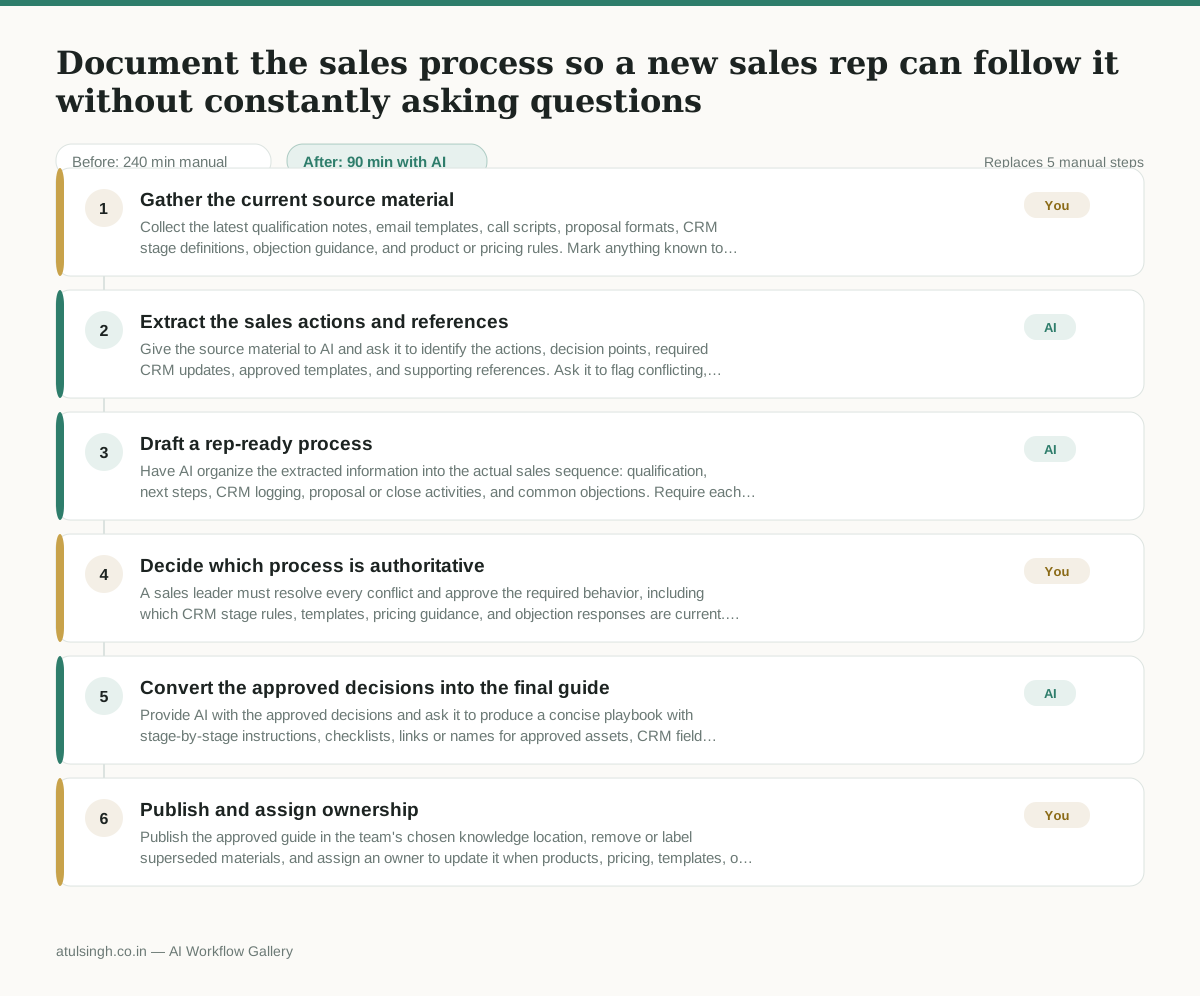
1. Gather the current source material
Collect the latest qualification notes, email templates, call scripts, proposal formats, CRM stage definitions, objection guidance, and product or pricing rules. Mark anything known to be outdated instead of silently treating it as current.
- AI
2. Extract the sales actions and references
Give the source material to AI and ask it to identify the actions, decision points, required CRM updates, approved templates, and supporting references. Ask it to flag conflicting, missing, or ambiguous instructions rather than choosing between them.
- AI
3. Draft a rep-ready process
Have AI organize the extracted information into the actual sales sequence: qualification, next steps, CRM logging, proposal or close activities, and common objections. Require each stage to include what the rep does, when to do it, what to record, and which approved template to use.
- You
4. Decide which process is authoritative
A sales leader must resolve every conflict and approve the required behavior, including which CRM stage rules, templates, pricing guidance, and objection responses are current. This decision determines what new reps will follow and which source materials must be retired or labeled as exceptions.
- AI
5. Convert the approved decisions into the final guide
Provide AI with the approved decisions and ask it to produce a concise playbook with stage-by-stage instructions, checklists, links or names for approved assets, CRM field requirements, objection responses, and a list of unresolved items. AI cannot verify that a template, price, or CRM rule is actually current, so retain human-approved references only.
- You
6. Publish and assign ownership
Publish the approved guide in the team's chosen knowledge location, remove or label superseded materials, and assign an owner to update it when products, pricing, templates, or CRM requirements change. Set a recurring review date and a clear process for reps to report gaps.
What you end up with
Where this falls apart
- The source materials contain conflicting pricing rules or CRM stage definitions and the human reviewer approves the AI output without resolving them, which produces a playbook that instructs new reps to take contradictory actions.
- The underlying sales process changes frequently due to new product releases and the assigned owner fails to update the source materials, which causes the AI to generate guides based on outdated qualification criteria.
More for RevOps / Sales Ops
- Find and merge duplicate contacts and companies, and flag stale deals before the monthly pipeline review
- clean up a messy CRM export and build a forecast the sales leader will actually trust for the board meeting
- Find and merge duplicate CRM records before the pipeline review
- Turn a raw CRM export into a sales forecast, flagging missing close dates before reporting
Also in revops
- Turn a recurring cross-team problem into a documented handoff
- mapping messy customer onboarding notes into our CRM and project management board
- finding out which team is dropping the ball on customer handoffs
- Checking monthly expense reports for unusual jumps in supply costs before sending them to finance