
Reviewing external market research reports and flagging unverified claims before presenting findings to the board.
Board presentations require factual backing, but raw market reports often contain broad generalizations, missing sample sizes, or unsupported claims that are difficult to catch manually under tight deadlines.
- Before
- 120 min
- After
- 45 min
- Saved
- 75 min
How this used to go
- Read through the full market research report section by section.
- Highlight statistics, market size figures, and growth projections.
- Cross-reference key claims against internal data or public sources to check for validity.
- List out specific assumptions, missing data points, or unverified claims in a separate tracking document.
- Draft a summary note highlighting these risk areas for the executive team.
Manually cross-referencing every single statistical claim against external sources takes a significant amount of time and is easy to miss when fatigue sets in.
The workflow, step by step
- You
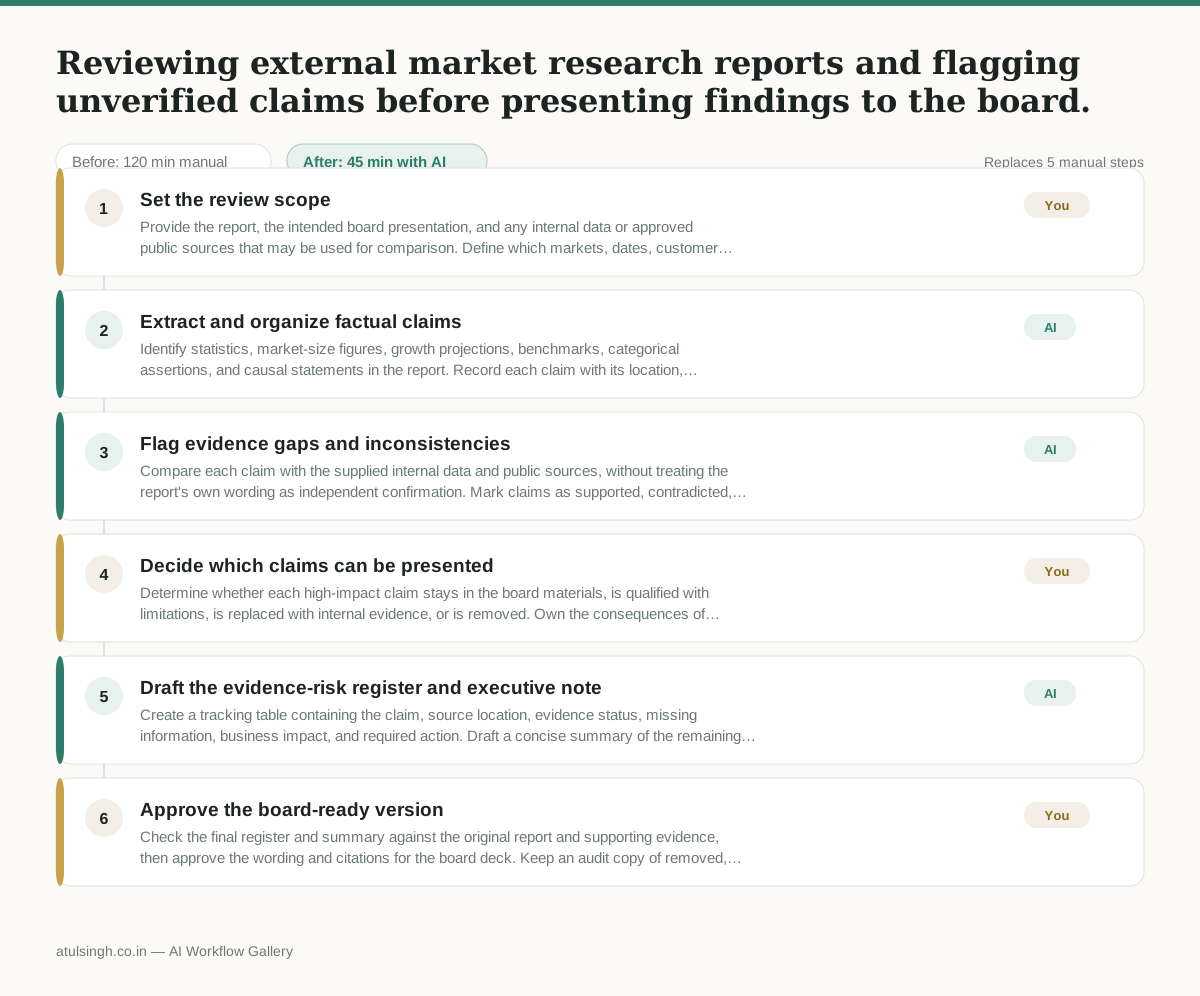
1. Set the review scope
Provide the report, the intended board presentation, and any internal data or approved public sources that may be used for comparison. Define which markets, dates, customer segments, and claim types require evidence.
- AI
2. Extract and organize factual claims
Identify statistics, market-size figures, growth projections, benchmarks, categorical assertions, and causal statements in the report. Record each claim with its location, wording, cited source, sample size, date, population, and stated assumptions when available.
- AI
3. Flag evidence gaps and inconsistencies
Compare each claim with the supplied internal data and public sources, without treating the report's own wording as independent confirmation. Mark claims as supported, contradicted, unclear, or unverified, and state what evidence is missing; AI cannot reliably confirm claims when source material is absent, inaccessible, or methodologically unclear.
- You
4. Decide which claims can be presented
Determine whether each high-impact claim stays in the board materials, is qualified with limitations, is replaced with internal evidence, or is removed. Own the consequences of presenting uncertain findings and escalate material contradictions to the report provider or research owner.
- AI
5. Draft the evidence-risk register and executive note
Create a tracking table containing the claim, source location, evidence status, missing information, business impact, and required action. Draft a concise summary of the remaining risks and approved qualifications for the executive team.
- You
6. Approve the board-ready version
Check the final register and summary against the original report and supporting evidence, then approve the wording and citations for the board deck. Keep an audit copy of removed, qualified, and unresolved claims.
What you end up with
Where this falls apart
- The source market research report relies on proprietary data behind paywalls or inaccessible databases, causing the AI to hallucinate confirmation or falsely label valid claims as unverified.
- The supplied internal data contains contradictory metrics without clear definitions, causing the AI to generate false contradictions in the evidence-risk register.
More for Marketing Manager
- Write a campaign brief that the agency and the internal design team can both use without contradictory instructions
- Check every lead capture form on the website to make sure submissions reach the right sales reps before launching a new advertising campaign.
- Checking multiple promotional calendars across email, social, and paid ads to make sure campaigns do not overlap or contradict each other before the holiday sales push.
- turning a detailed product spec sheet into a clear campaign brief for the design team without keeping all the technical jargon
Also in marketing
- Turn a recorded customer interview into a draft blog post
- Sorting incoming customer leads from web forms and assigning them to the right sales reps based on company size and location
- Turn a technical whitepaper into a three-part email nurture sequence before it launches
- Analyze competitor viral posts to draft three trend hooks, discarding off-brand angles