
Reply to inbound beta signups to figure out if they are a real fit before getting on a call
Founders spend too much time manually looking up every single beta user who signs up, trying to guess if they have the actual problem the product solves, resulting in wasted calls with people who cannot use or buy the product.
- Before
- 10 min
- After
- 4 min
- Saved
- 6 min
How this used to go
- Get a notification when a new user signs up for the beta.
- Open LinkedIn or the company website to look up the person and their business.
- Check their company size and industry to see if it matches the target profile.
- Review any notes they left in the signup form about their current setup.
- Decide whether to send a qualifying questionnaire, invite them straight to a call, or ignore them.
Manually researching every single lead takes up chunks of the day, delaying the first response and often leading to poorly qualified calls.
The workflow, step by step
- AI
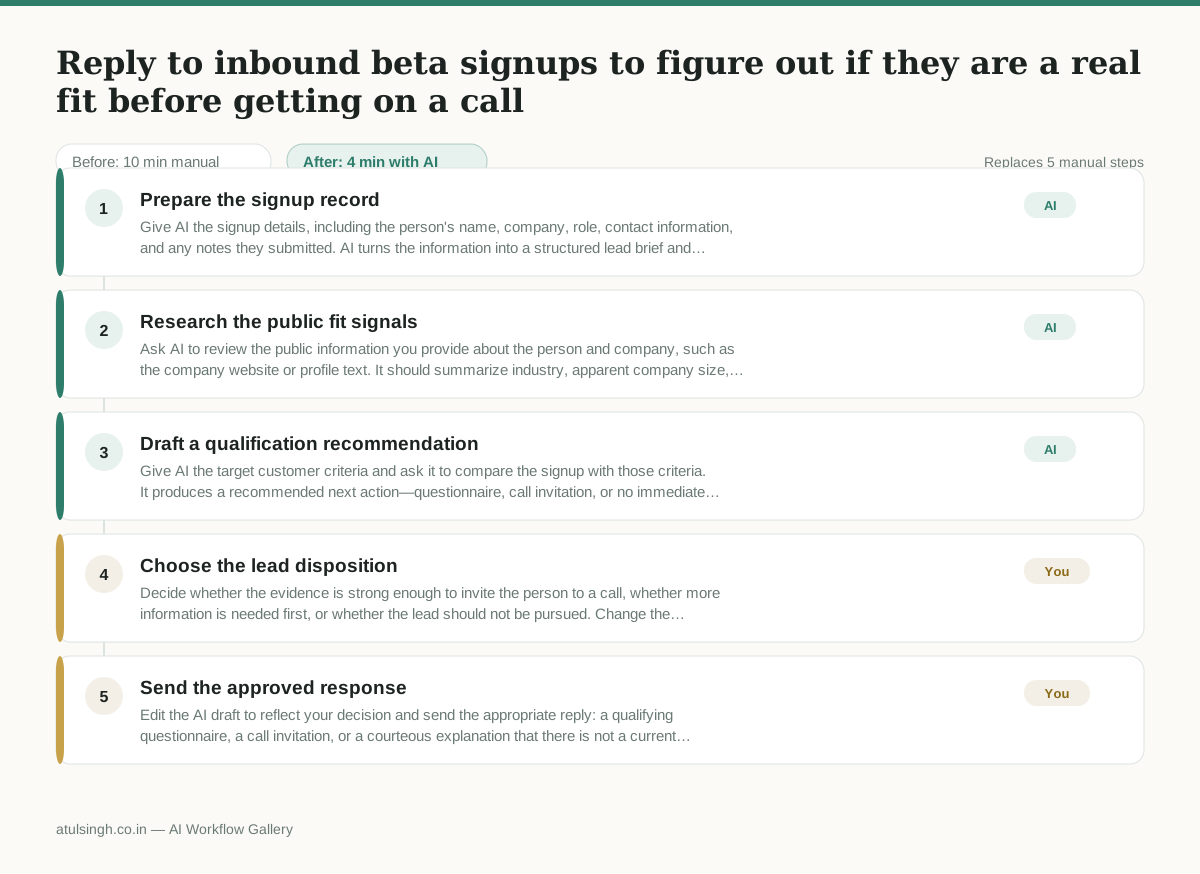
1. Prepare the signup record
Give AI the signup details, including the person's name, company, role, contact information, and any notes they submitted. AI turns the information into a structured lead brief and marks fields that are missing or ambiguous.
- AI
2. Research the public fit signals
Ask AI to review the public information you provide about the person and company, such as the company website or profile text. It should summarize industry, apparent company size, role, and relevant signs of the problem without treating guesses as facts.
- AI
3. Draft a qualification recommendation
Give AI the target customer criteria and ask it to compare the signup with those criteria. It produces a recommended next action—questionnaire, call invitation, or no immediate follow-up—along with supporting evidence, unknowns, and a reply draft.
- You
4. Choose the lead disposition
Decide whether the evidence is strong enough to invite the person to a call, whether more information is needed first, or whether the lead should not be pursued. Change the recommendation when the public evidence is weak, contradictory, or based on an unreliable inference.
- You
5. Send the approved response
Edit the AI draft to reflect your decision and send the appropriate reply: a qualifying questionnaire, a call invitation, or a courteous explanation that there is not a current fit. Record the disposition and any follow-up question in the lead record.
What you end up with
Where this falls apart
- The sign-up uses a personal email address with no company website provided, which leaves the AI with insufficient public data to determine company size or industry.
- The sign-up form contains intentionally misleading or fabricated company details, which causes the AI to generate an incorrect qualification recommendation.
More for Founder-led Sales
- reaching out to former colleagues and personal contacts to announce a new company or product launch without sounding like a spammy marketer
- Turn raw discovery call notes into a structured pilot proposal for a new client
- following up on proposals that went quiet without annoying the prospect
- Outline a custom proof-of-concept project plan after an enterprise discovery call
Also in sales
- Research an incoming company and its decision makers before a first sales meeting
- Prep for a B2B demo call by checking recent company news, job postings, and tech stack changes to build relevant questions.
- Reviewing a new sales rep's practice pitch against the team's call criteria before letting them talk to real prospects
- Reviving deals that went quiet after sending a proposal by finding matching case studies and writing a follow-up message.