
Reviewing support chatbot transcripts to find where customers get stuck and sending those failed conversations to the team that updates the training data.
Support leads spend hours reading through hundreds of chat logs manually to find loops where the bot repeats itself or fails to answer, meaning many failed interactions go unnoticed until customers complain.
- Before
- 120 min
- After
- 45 min
- Saved
- 75 min
How this used to go
- Export the previous week's chat transcripts from the support platform into a spreadsheet.
- Filter out resolved chats that ended in a successful handoff to a human agent.
- Read through remaining unresolved or abandoned chat threads one by one.
- Identify repetitive loops where the chatbot failed to understand the customer's intent.
- Copy the specific chat snippets and customer queries into a tracking document.
- Email the compiled list of unhandled intents to the chatbot trainers for updates.
Reading through dozens of dead-end chat logs where customers just typed frustrated gibberish or repeated the same failed question four times.
The workflow, step by step
- You
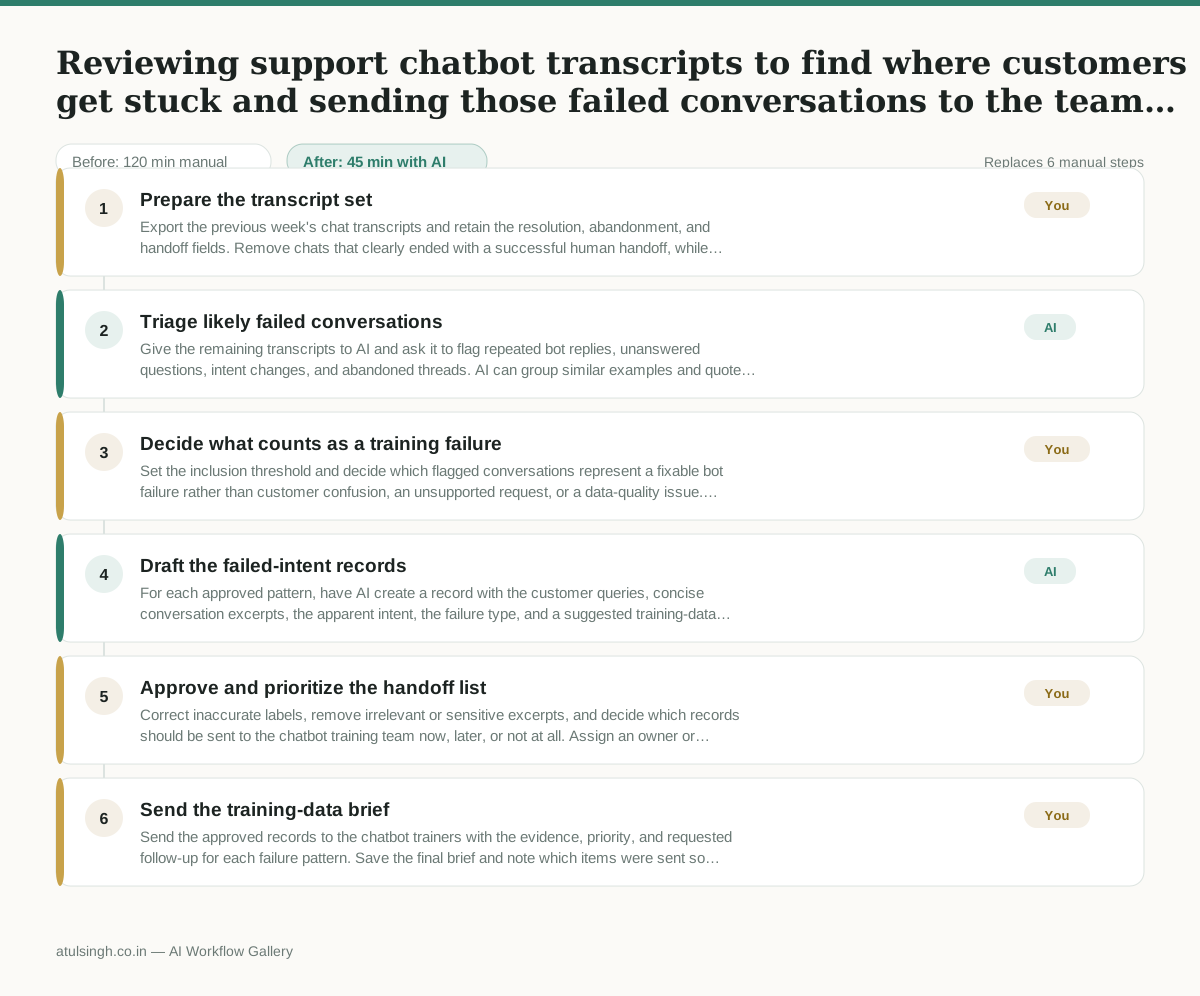
1. Prepare the transcript set
Export the previous week's chat transcripts and retain the resolution, abandonment, and handoff fields. Remove chats that clearly ended with a successful human handoff, while keeping unresolved and abandoned conversations for analysis.
- AI
2. Triage likely failed conversations
Give the remaining transcripts to AI and ask it to flag repeated bot replies, unanswered questions, intent changes, and abandoned threads. AI can group similar examples and quote the relevant messages, but it cannot reliably determine intent from short, frustrated, or nonsensical messages.
- You
3. Decide what counts as a training failure
Set the inclusion threshold and decide which flagged conversations represent a fixable bot failure rather than customer confusion, an unsupported request, or a data-quality issue. Prioritize cases that affect important customer tasks or show the same failure pattern across multiple chats.
- AI
4. Draft the failed-intent records
For each approved pattern, have AI create a record with the customer queries, concise conversation excerpts, the apparent intent, the failure type, and a suggested training-data change. Treat the intent and suggested change as drafts that require human confirmation.
- You
5. Approve and prioritize the handoff list
Correct inaccurate labels, remove irrelevant or sensitive excerpts, and decide which records should be sent to the chatbot training team now, later, or not at all. Assign an owner or priority where the team needs a clear next action.
- You
6. Send the training-data brief
Send the approved records to the chatbot trainers with the evidence, priority, and requested follow-up for each failure pattern. Save the final brief and note which items were sent so the next transcript review can check whether the same failures recur.
What you end up with
Where this falls apart
- Customers use heavily fragmented sentences or shorthand slang because the model misinterprets their intent and flags valid interactions as failures.
- Transcripts contain lengthy multi-topic customer sessions because the model conflates unrelated conversational threads into a single incorrect failure pattern.
More for Customer Support Lead
- Review last week's support tickets and find the three macros that need rewriting
- score a sample of agent replies against the team's quality checklist
- Reviewing last week's support tickets to update macros and remove outdated responses before sharing them with the team
- Write the escalation summary before handing a stuck ticket to engineering
Also in support
- Checking whether a client account is confidential before publishing a case study or sharing details externally
- Identifying which accounts are ready for an expansion conversation based on their product usage and feature adoption data.
- Prepare a quarterly business review deck for a customer account using product usage data and past support tickets
- spot which accounts are at renewal risk before the renewal call