
Reviewing customer health scores and writing account intervention plans before renewal calls
Customer Success Managers often spot dropping health scores too late or miss the specific usage trends driving the decline, leading to unorganized prep work and defensive renewal conversations.
- Before
- 45 min
- After
- 25 min
- Saved
- 20 min
How this used to go
- Export the current list of accounts up for renewal in the next 60 to 90 days from the CRM.
- Check product usage data and login frequencies for each account to identify negative trends or drops in engagement.
- Review recent support tickets and notes from previous check-ins to find recurring complaints or unresolved issues.
- Synthesize the usage data and support history into a written summary of why the account's health score is dropping.
- Draft a custom intervention plan and talking points to address the risk factors during the upcoming renewal call.
Manually cross-referencing support tickets, usage metrics, and CRM notes for every single account takes too much time before you can even start planning how to fix the relationship.
The workflow, step by step
- You
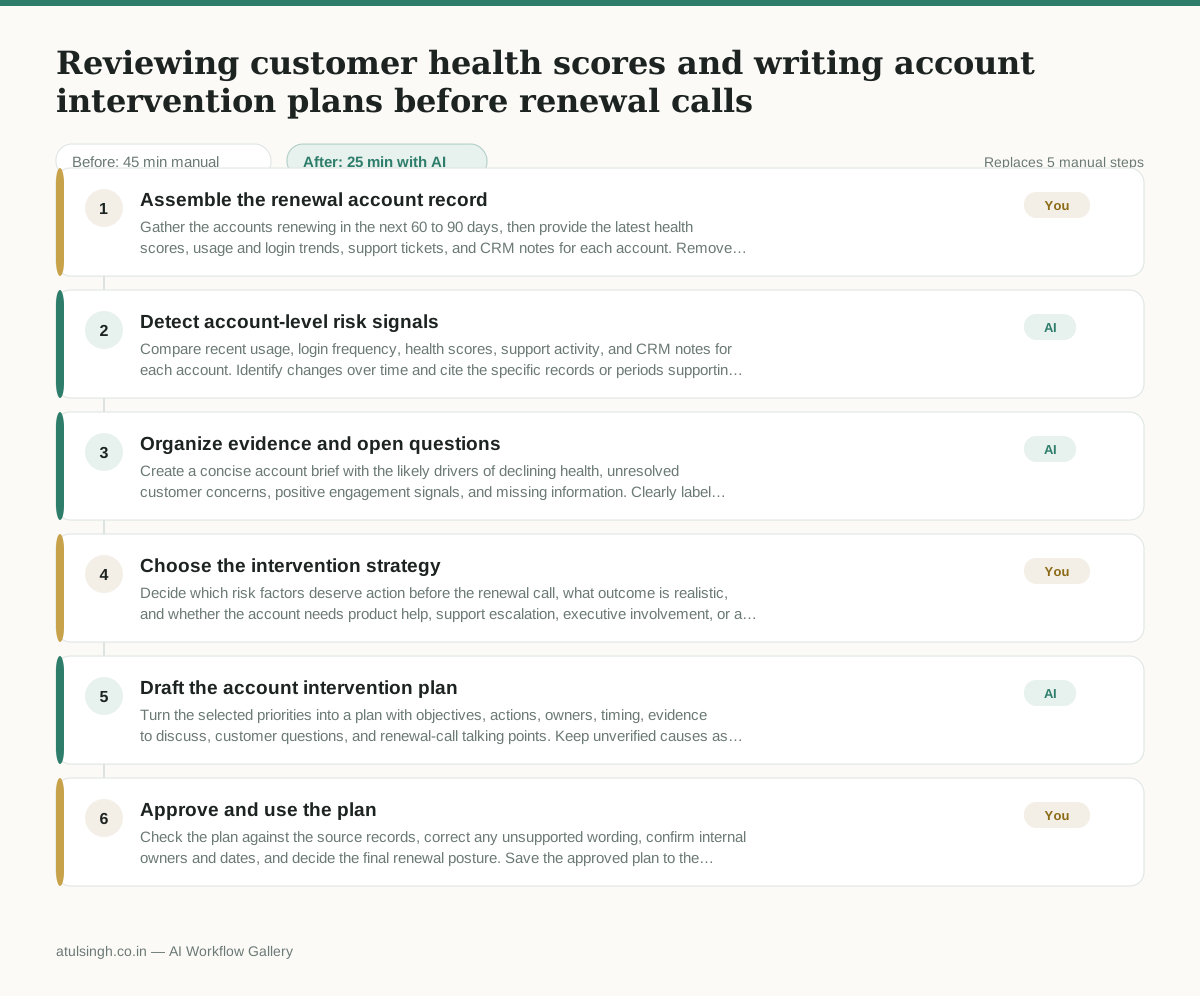
1. Assemble the renewal account record
Gather the accounts renewing in the next 60 to 90 days, then provide the latest health scores, usage and login trends, support tickets, and CRM notes for each account. Remove unrelated or outdated records before analysis.
- AI
2. Detect account-level risk signals
Compare recent usage, login frequency, health scores, support activity, and CRM notes for each account. Identify changes over time and cite the specific records or periods supporting each risk signal rather than treating correlation as a confirmed cause.
- AI
3. Organize evidence and open questions
Create a concise account brief with the likely drivers of declining health, unresolved customer concerns, positive engagement signals, and missing information. Clearly label assumptions and flag causes that require confirmation with the customer or internal teams.
- You
4. Choose the intervention strategy
Decide which risk factors deserve action before the renewal call, what outcome is realistic, and whether the account needs product help, support escalation, executive involvement, or a discovery conversation. Reject unsupported explanations and assign an owner and deadline for each chosen action.
- AI
5. Draft the account intervention plan
Turn the selected priorities into a plan with objectives, actions, owners, timing, evidence to discuss, customer questions, and renewal-call talking points. Keep unverified causes as questions or hypotheses, not statements of fact.
- You
6. Approve and use the plan
Check the plan against the source records, correct any unsupported wording, confirm internal owners and dates, and decide the final renewal posture. Save the approved plan to the account record and use the questions and talking points to guide the renewal call.
What you end up with
Where this falls apart
- The underlying CRM notes and support tickets contain outdated or inaccurate information, which causes the model to generate false risk signals and incorrect intervention priorities.
- Customer interactions happen outside of tracked support channels and CRM notes, causing the model to miss critical relationship context and produce incomplete account briefs.
More for Customer Success Manager
- Checking whether a client account is confidential before publishing a case study or sharing details externally
- Identifying which accounts are ready for an expansion conversation based on their product usage and feature adoption data.
- Prepare a quarterly business review deck for a customer account using product usage data and past support tickets
- spot which accounts are at renewal risk before the renewal call
Also in support
- Review last week's support tickets and find the three macros that need rewriting
- score a sample of agent replies against the team's quality checklist
- Reviewing last week's support tickets to update macros and remove outdated responses before sharing them with the team
- Write the escalation summary before handing a stuck ticket to engineering