
The best way to create a content brief with AI is to give the model a clear task contract. Define who the reader is, the question they need answered, the decision the content should support, the evidence the writer must use and the topics the draft should leave out.
Start with those fields before asking for headings or keywords. Then ask AI to turn the information into a short, structured brief that a writer can use without guessing. A useful brief gives the writer direction and judgement room, rather than a long list of search terms.
The short answer: brief the decision, not the keyword
A content brief should help a writer answer four practical questions:
- Who is this for, and what do they already know?
- What specific question brought them here?
- What proof will make the answer credible?
- Which familiar angles, claims or sections should stay out?
You can ask an AI tool to organise these details, identify missing information and suggest a structure. You still need to provide the source material and approve the decisions. The model can arrange context, but the content lead remains responsible for accuracy, relevance and risk.
A good brief also states the action the reader should be able to take after reading. For a sales article, that could be choosing between two approaches. For a support article, it could be diagnosing a problem safely. For a marketing article, it could be deciding whether a workflow is suitable for the team.
This focus helps avoid a common failure mode: a brief that contains many keywords but gives the writer no useful understanding of the reader. Google Search Central advises creators to assess whether content answers who, how and why, provides original value and serves people rather than search traffic alone (Google Search Central, 2023).
Why this matters for small content teams
Content teams often have enough ideas and too little shared clarity. In the Content Marketing Institute and MarketingProfs' 2025 B2B survey of 980 marketers, 58% rated their organisation's content marketing strategy as only moderately effective. Nearly half of the respondents who were struggling identified a lack of clear goals as the root cause (Content Marketing Institute and MarketingProfs, 2024).
A brief can make the goal visible before drafting starts. It gives a freelance writer a reliable handover, gives an editor a review standard and gives a decision maker a chance to correct the direction before hours are spent on prose.
The same survey found that only roughly one in three B2B marketers had a scalable model for content creation, while limited resources remained the leading operational difficulty (Content Marketing Institute and MarketingProfs, 2024). A small, repeatable briefing workflow can reduce avoidable revisions without turning content into a rigid production line.
AI is useful here because it can turn scattered inputs into a consistent format. It can compare a source pack with the proposed brief, flag unsupported claims and show where the writer still needs a subject matter expert. It should not be trusted to invent the evidence that the brief requires.
The five fields that change the draft
A practical AI content brief can contain more fields, but these five usually have the greatest effect on the finished article.
1. Reader profile. Describe the reader's role, situation, knowledge level and immediate pressure. “Marketing manager at a small software company” is a starting point. “Needs to brief a freelance writer by Friday and has limited internal subject matter expertise” gives the writer a usable situation.
2. Primary question. State the one question the article must answer. Supporting questions can be listed later, but one primary question keeps the draft from becoming a collection of loosely related sections.
3. Useful decision. Explain what the reader should be able to decide or do after reading. This creates a test for every proposed section. If a paragraph does not help with that decision, it may belong in another article.
4. Proof requirements. List the sources, internal documents, customer evidence, expert input or examples the writer may use. Mark which claims require verification. If the brief has no approved evidence for an assertion, instruct the writer to leave the claim out or flag it for review.
5. Out of scope. State what should be excluded. This could include basic definitions the audience already knows, a competing angle, unsupported statistics, product claims, generic introductions or a list of tools that the article does not need.
These fields are more useful than a keyword dump because they shape the reader's experience. They also give AI meaningful constraints. The Nielsen Norman Group's CARE framework recommends supplying context, the ask, rules and examples so that a model has enough information to produce a usable business asset (Nielsen Norman Group, 2024).
A step-by-step AI briefing workflow
Use the following sequence in your preferred AI tool. Keep the source material in the same working space where possible, and tell the model what it may and may not assume.
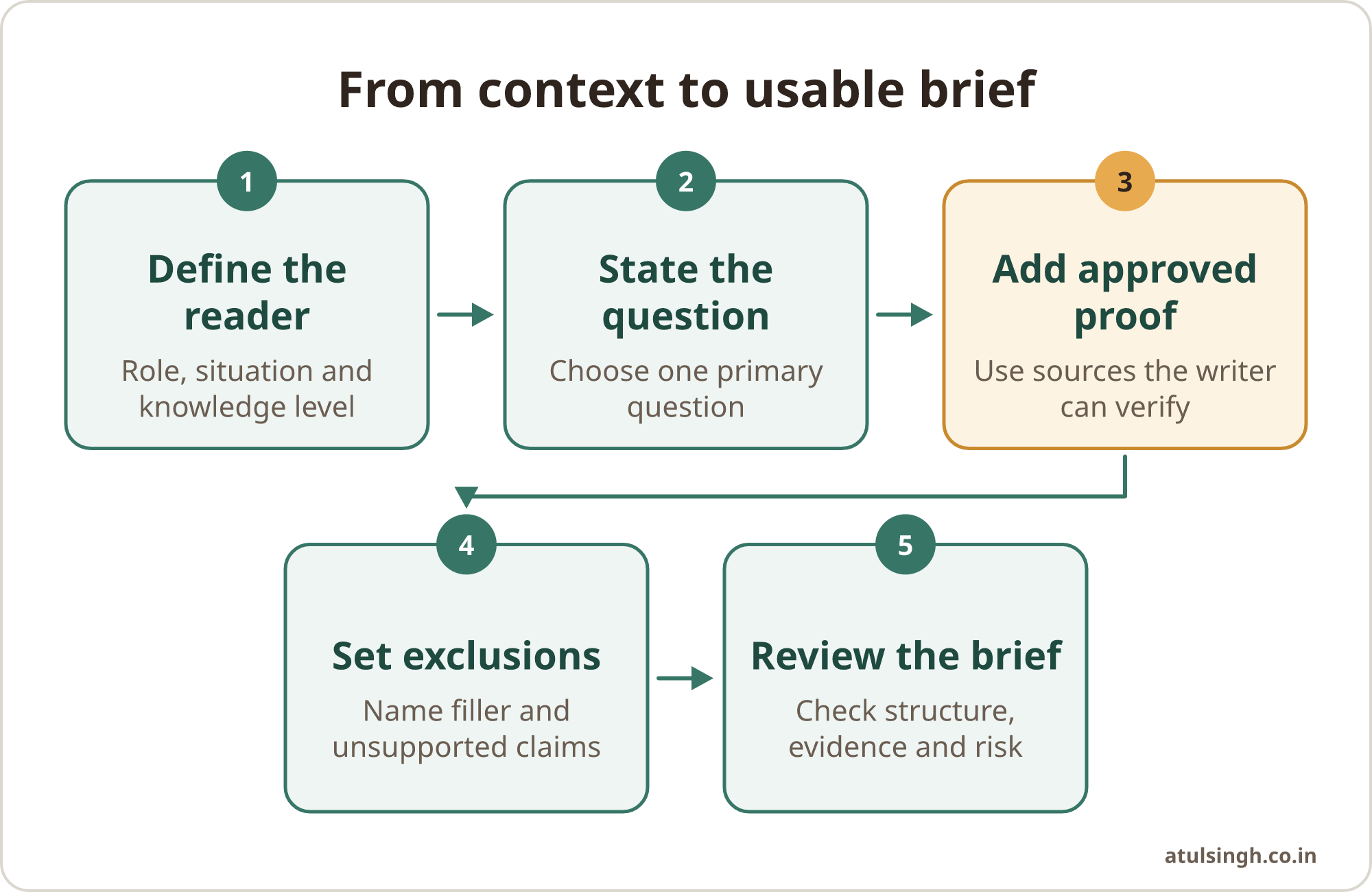
Step 1: Write the assignment in plain language. Begin with the business purpose, audience, primary question and desired reader decision. Do not start with “generate an SEO article”. Start with the job the content needs to do.
Step 2: Add the source pack. Include approved research, product documentation, interview notes or internal guidance. Label each source clearly. If a source is incomplete, say so. A model should be able to distinguish verified material from an idea that still needs checking.
Step 3: Ask for gaps before structure. Tell AI to identify missing audience information, weak evidence and ambiguous claims. This is more valuable than asking for ten headings immediately. Resolve important gaps with the subject matter expert or content lead.
Step 4: Generate the brief fields. Ask for the reader, primary question, decision, proof requirements, exclusions, proposed angle, section purpose and review risks. Require a short explanation for each recommendation so the writer can understand the reasoning.
Step 5: Test the structure against the question. Ask AI to explain how each section helps the reader reach the intended decision. Remove sections that only repeat common knowledge or imitate a competing article.
Step 6: Run a human review. Check the facts, source permissions, brand requirements, privacy boundaries and commercial claims. The final brief should be short enough for a writer to scan before drafting.
This sequence works because it separates understanding from production. It also follows the principle of giving a model a defined task, inputs, output format, domain context, negative constraints and a fallback for missing details. Anthropic describes this kind of explicit context as part of effective context engineering for reliable AI workflows (Anthropic, 2025).
A prompt you can adapt
Create a content brief for a writer using the source material below.

Business purpose:
[What the content needs to achieve]

Reader:
[Role, situation, knowledge level and pressure]

Primary question:
[One question the article must answer]

Reader decision:
[What the reader should decide or do]

Approved sources:
[Paste or list source material]

Rules:
- Use only claims supported by the sources.
- Mark any missing evidence as "needs verification".
- Recommend a structure that answers the primary question early.
- Use plain English and explain specialist terms only when needed.
- Include an explicit "Out of scope" section.

Return:
1. Reader profile
2. Primary question
3. Reader decision
4. Required proof
5. Proposed angle
6. Section plan with purpose and evidence
7. Out of scope
8. Open questions for the content lead
The reasons behind the rules matter. “Do not use unsupported statistics because the writer needs to protect the publication's credibility” gives useful context. Bare prohibitions can be followed mechanically while the larger purpose is missed.
What the brief looks like in real work
Marketing example. Say a ten-person agency wants an article about refreshing old content. The reader might be a marketing manager with a library of published pages, limited reporting time and uncertainty about which pages deserve attention. The brief should require evidence from the agency's approved audit method, explain how to choose a page and exclude a broad tour of every SEO tool.
Sales example. A sales team might need an article for prospects comparing manual account research with an AI-assisted workflow. The reader's question could be how to use AI without sending inaccurate or sensitive information to a prospect. The brief should require a review step, clear data boundaries and a realistic example of human judgement. It should leave out claims about guaranteed conversion improvements unless verified evidence exists.
Customer support example. A support lead might commission an article explaining how to prepare a knowledge base for an internal chatbot. The reader needs to decide which documents are ready for use and which require revision. The proof field could require links to approved policies and escalation rules, while the exclusions could remove speculative advice about automating sensitive cases.
These examples show why the same topic can need different briefs. A writer cannot produce a useful draft from the topic alone. The operational context determines the examples, level of detail, risks and evidence.
If the work feeds a wider marketing system, it helps to connect the brief to the next workflow rather than leave it in a document folder. A set of AI marketing workflows for real pipeline can show where research, content review and reporting fit around the writing task.
A brief checklist for the handover
Use this checklist before sending the brief to a writer.
| Brief field | Check before drafting |
|---|---|
| Reader | Can the writer picture the reader's role, context and knowledge? |
| Question | Is there one primary question rather than a topic label? |
| Decision | Is the reader's next decision or action clear? |
| Proof | Does every important claim have an approved source or owner? |
| Structure | Does each section serve the primary question? |
| Exclusions | Are filler, duplicated angles and unsupported claims named? |
| Voice | Are tone, terminology and audience expectations clear? |
| Review | Does someone own fact checking and final approval? |
Keep the document concise. A long brief can become another research task for the writer, especially when it contains competing instructions. Web-writing research from the Nielsen Norman Group found that generative text often needs firm structural direction to maintain scannability, concision, clear language and an appropriate information order (Nielsen Norman Group, 2025).
For voice and terminology, keep a separate reference sheet if the organisation publishes frequently. A brand voice guardrail system can hold recurring style rules, banned patterns and review checks, leaving each content brief focused on the reader and assignment.
Common mistakes and sensible limits
Starting with keywords. Keyword data can help you understand language and demand, but a list of terms cannot define the reader's problem or the value your article adds. Ask AI to use keyword information as a supporting input after the audience and question are clear.
Letting AI supply proof. A model may produce plausible statistics, quotes or studies that do not exist. Require source links or approved internal references for every proof point. If the evidence is missing, the brief should say “needs verification” rather than filling the gap.
Overloading the rules. A brief with dozens of micro-instructions can create stiff, repetitive copy. Keep the constraints that protect the reader, accuracy, privacy, brand and business purpose. Let the writer choose natural wording within those boundaries.
Uploading sensitive material casually. Customer interviews, unreleased product information and proprietary research need a clear data policy. Public AI tools may create privacy, copyright or retention risks when sensitive material is uploaded without suitable controls. A small team should define approved tools and information boundaries before making AI briefing routine.
Skipping editorial judgement. AI can identify a missing source or suggest a clearer section order. It cannot take responsibility for a regulated claim, a customer promise or a reputation-sensitive argument. Keep human approval where money, customers or trust are involved.
If several people contribute to the same assignment, a structured campaign brief workflow can reduce contradictory instructions before the writer starts.
Where to start on Monday
Choose one recurring article type and create a single brief template with the five core fields: reader, question, decision, proof and out of scope. Test it on the next assignment with one writer. Ask the writer which fields prevented guessing and which instructions created unnecessary work.
Then save the approved version with the source pack and review responsibilities. The aim is a small system that the team can run without an AI specialist standing beside it. Improve the template when a real draft exposes a gap.
A content brief becomes useful when it changes the work before writing begins. Give AI enough context to organise the assignment, give the writer enough judgement room to produce clear copy and keep a person responsible for evidence and final decisions.
For teams that want to build this kind of workflow through guided practice, the AI Accelerator for marketing teams focuses on using AI for research, content, campaigns and reporting with human review built into the process.