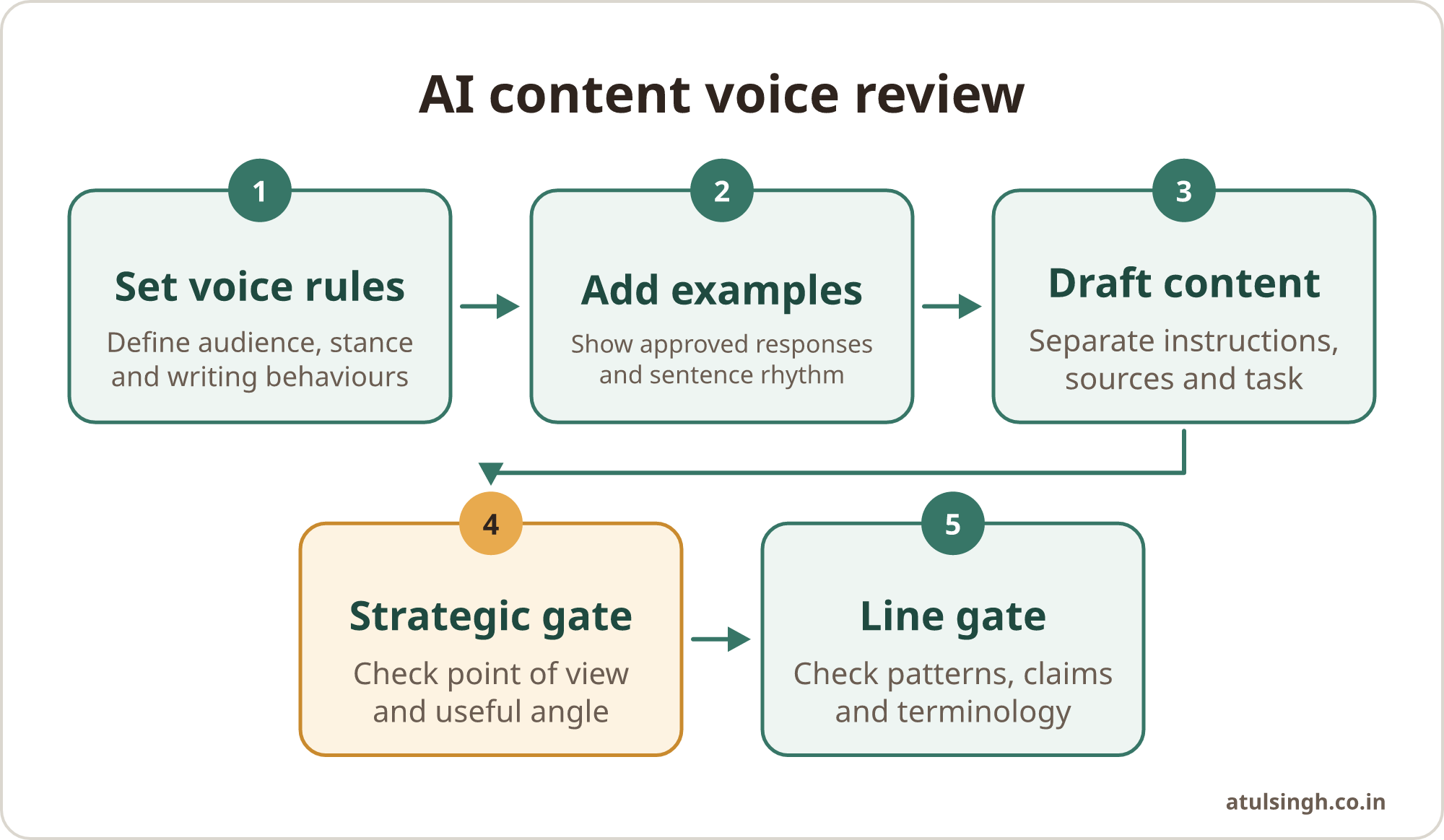
AI-generated content stays consistent when you give the model specific writing rules, approved examples and clear boundaries. Add a short human review step before anything reaches a customer, prospect or public channel.
A useful system has four parts: a one-page voice sheet, a list of unwanted patterns with acceptable replacements, two or three examples of approved writing, and a review process that checks message quality and sentence-level style. This gives content and brand managers something they can maintain, test and use across marketing, sales and customer support.
The short answer: build a small voice system
Words such as friendly, professional and engaging describe intentions. They give an AI model limited guidance about how a sentence should sound. OpenAI guidance notes that vague instructions leave the model to infer intent from common patterns, which often produces generic corporate language (OpenAI Prompt Engineering guidance, 2024).
Replace abstract adjectives with observable rules. State who is speaking, who is being addressed, how long sentences should be, which terms to use, which terms to avoid and what the reader should do next.
Then add examples. A model can follow a description, but approved examples show details that are hard to explain, such as sentence rhythm, warmth, technical language and how directly the brand handles uncertainty. Anthropic recommends using carefully chosen examples to guide format and tone (Anthropic, Prompting best practices).
The final part is a human gate. The reviewer should check the argument, claims, customer impact and brand fit before polishing grammar. Consistent tone alone does not prove that content is safe or accurate.
Why voice guardrails matter for small teams
AI makes it easy to produce more drafts, campaign variations, sales messages and support replies. Without editorial ownership, the extra volume can create repeated phrases, weak claims and a recognisable generic style. Content Marketing Institute research links increased AI adoption with content overload and quality friction when operational review is weak (Content Marketing Institute, 2025).
Generic output also creates a differentiation problem. NIST identifies harmful bias and homogenisation as a major generative AI risk category. When businesses use foundation models without enough direction, their language can converge on the same structures and industry phrases (NIST AI 600-1).
This affects several parts of a small business. Marketing may publish useful information in a voice that sounds like every competitor. Sales may send polished but impersonal outreach. Support may give a technically correct answer that feels dismissive because it does not reflect the company’s way of handling concerns.
A voice system gives people a shared operating standard and makes editing faster. If the wider process includes research, drafting, checking and publishing, repeatable AI marketing workflows can connect voice review to the rest of the work.
Create the one-page voice sheet
Keep the first version short enough to use every day. A long brand manual may contain useful context, but copying all of it into every prompt can dilute the important instructions. Include only the decisions the model needs for the task.
Use clear sections, separated from source material and the current task. Structured delimiters, such as XML-style labels or triple quotation marks, help distinguish instructions from reference copy (Anthropic, Prompting best practices).
| Section | What to define | Example instruction |
|---|---|---|
| Role and audience | Who speaks and who listens | Speak as a practical adviser to operations managers in small businesses. |
| Positive rules | Sentence, structure and vocabulary choices | Use active voice, plain English and short paragraphs. |
| Unwanted patterns | Phrases and habits that weaken the voice | Avoid inflated claims, rhetorical openings and empty summaries. |
| Approved examples | Responses showing the intended voice | Include a customer question and a product explanation. |
| Review conditions | What a person must verify | Check claims, sensitive information, customer impact and next action. |
Role and audience. Define the perspective in two sentences. Include the reader’s knowledge, likely concern and the stance the business wants to take. A support assistant may need to sound calm and accountable, while a sales assistant may need to be concise and relevant to the prospect’s situation.
Positive rules. Describe behaviours that can be checked. Ask for active voice, varied sentence lengths, short paragraphs, concrete verbs and a direct answer before background. Tell the model to state when information needs confirmation instead of guessing.
Approved examples. Add two or three pairs showing a customer question or content brief alongside the response the brand approves. Cover different situations rather than repeating one sentence pattern. Anthropic’s guidance recommends examples as a reliable way to steer tone, format and style (Anthropic, Prompting best practices).
Review conditions. Tell the reviewer what requires judgement. Claims about results, pricing, compliance, refunds, customer commitments and product capabilities deserve a person’s attention even when the wording looks consistent.
Turn vague preferences into visible rules
A voice sheet works when another person can use it without asking what approachable means. Translate each preference into a behaviour and an example.
Replace approachable with instructions such as: use plain words, answer the question in the first sentence, acknowledge the concern without over-apologising and finish with one clear next action. Replace expert with: explain the reasoning, define specialist terms on first use and avoid claims that cannot be checked.
The same method works for brand values. If a company values transparency, the writing rules could say to separate known facts from assumptions, name relevant limitations and state what the team will check. If it values efficiency, the rules could say to remove repeated context, use descriptive headings and put the required action near the start.
A useful test is to remove the adjectives from the sheet. If the remaining instructions still tell a writer how to construct the response, the sheet is becoming operational rather than aspirational.
Build a pattern list with replacements
A list of unwanted phrases can help remove common AI habits, but it needs useful alternatives. OpenAI and Anthropic recommend combining negative constraints with clear alternatives and positive examples (OpenAI Prompt Engineering guidance, 2024).
| Unwanted pattern | Preferred replacement |
|---|---|
| Empty opening about an entire industry | Start with the reader’s practical problem. |
| Inflated terms such as breakthrough or exceptional | Use a precise verb that describes the action or result. |
| Rhetorical question as an introduction | State the situation directly. |
| Three points with identical rhythm | Vary the structure and include a specific example. |
| Generic summary ending | Finish with an operational next step. |
| Unqualified claims about outcomes | State the condition, evidence or limitation. |