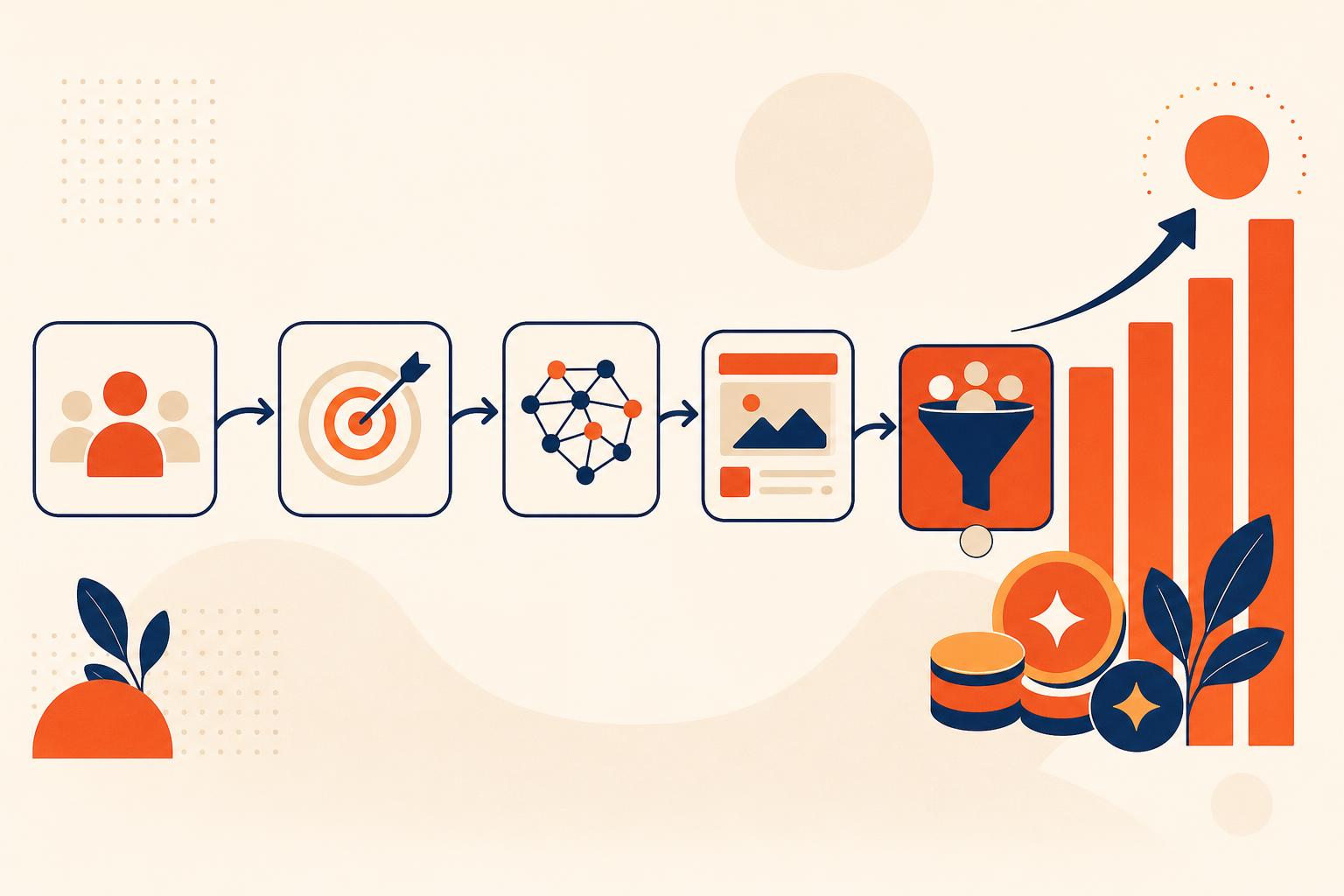
Most marketing teams use AI every day, but their pipeline stays flat. The missing piece is usually a repeatable AI marketing workflow tied to a business outcome. The gap between using AI and using it to create revenue is where most teams get stuck. If you want to understand why everyday AI use still produces little business value, read about the AI adoption gap and how teams can cross it.
The teams that make progress stop treating AI as a content generator and start building workflows. A workflow is just a repeatable process where AI handles a specific job, and that job connects to a real business outcome. This article walks through ten of those workflows — the kind you can set up without a developer — plus the simple rules that keep your output useful instead of generic.
What is an AI marketing workflow?
There is a big difference between opening a chat tool, typing a vague request, and hoping for something usable — and running a documented process that produces the same quality every time.
01 Repeatable
A clear sequence of steps and prompts any teammate can follow to get a similar result.
02 AI-assisted
Not AI-replaced. A human still owns judgement, accuracy, and final quality.
03 Connected to pipeline
You can trace the work back to a lead created, an opportunity opened, or a deal moved forward.
Here is the simple test. If you cannot connect the work to a measurable outcome, it is not a workflow — it is an experiment. Experiments are fine, but do not confuse them with a system that grows your pipeline.
Why AI marketing workflows fail
Slop is generic content pushed out to everyone with no strategy behind it. It looks like marketing. It reads like marketing. It just does not move the business.
I see the same pattern again and again. The prompts are vague, with nothing about who the buyer is or what they care about. The brand voice never makes it into the tool, so everything sounds the same. Nobody edits or fact checks before publishing. And success gets measured by how many pieces went out, not how many leads came in. The result is more blog posts, more emails, more social activity — and a pipeline that barely moves. A B2B content gap auditor can help you compare planned output with buyer objections, funnel drop-offs, and the evidence your audience actually needs.
Slop pattern
- · Vague, context-less prompts
- · No brand voice in the tool
- · Publish without human review
- · Measure volume, not pipeline
Pipeline pattern
- ✓ Buyer context + proof points loaded
- ✓ Brand voice reference in every prompt
- ✓ Human editor before anything ships
- ✓ Tracked against MQLs and pipeline $
If that sounds familiar, you are not alone. It is the default outcome when AI is used as a volume machine rather than a workflow.
The 4-part test that separates pipeline from slop
Before you build anything, run the idea through these four questions. If it fails any of them, fix that part first.
Ties to a revenue outcome
Every workflow connects to one number — an MQL, an opportunity, a deal influenced. No number, no workflow.
Built on repeatable steps
Write down inputs, context, and prompt. A one-time prompt is an experiment. A documented one is a workflow your team can run.
Human review before ship
AI drafts, humans approve. Every output passes someone who knows your brand and can catch a wrong fact or off-tone line.
Measured against pipeline
Track leads, pipeline created, and conversion — not posts published. The question is never how much you made; it's how much pipeline you created.
"If you cannot connect the work to a measurable outcome, it is not a workflow. It is an experiment."
How AI marketing workflows are changing in 2026
Two things have changed in the last year, and an honest article has to say so.
First: the move from prompts to systems. A year ago, good AI use meant writing a sharp prompt. Today, the strongest teams are stringing those prompts into multi-step workflows — sometimes run by AI agents — that handle whole jobs from research to draft to follow-up. The ten workflows below are exactly this.
2024
Prompts
One sharp question → one answer
2025
Systems
Chained prompts → documented workflows
2026
Agents
Multi-step jobs from research to ship
Second, and bigger: people now get answers straight from AI tools like ChatGPT, Perplexity, and Google's AI Overviews — often without ever clicking a website. Zero-click searches are now the majority of all searches. AI Overviews show up on roughly half of Google searches in the US.
What that means for you is simple. Ranking on Google is no longer enough. You now also need your content to be the source that AI tools quote when they answer a question. This practice has a name: Answer Engine Optimization (AEO), and it changes how you write and structure content.
10 practical AI workflows that generate pipeline
These AI marketing workflows cover time-consuming tasks for content marketers, growth marketers, and founders who do their own marketing. You can run all of them with tools you probably already have. Before choosing tools for these workflows, compare AI tools for small business by task, cost, and limitations rather than by novelty. To test whether a tool will work beyond a first experiment, follow our advice on how to evaluate AI marketing tools using real marketing work.
Account research in under five minutes
Pull a target account's facts, news, hiring signals, and tech stack into one brief.
Use AI to assemble what used to take half an hour of digging into a few minutes. That brief becomes the base for every personal touch you send that account — emails, ads, and sales calls.
Competitor and search analysis for content briefs
Study the pages already ranking, pull out headings, common questions, and gaps.
You get a clear brief before you write a single word. Fewer rewrites, faster publishing, and content that actually competes — instead of guessing what the SERP wants.
Faster blog and landing page drafts
Feed AI a detailed brief, brand voice, and proof points — let it produce the first draft.
A human editor shapes voice and accuracy. The trick is the context. When AI knows your product, audience, and tone, the draft needs far less editing. Blank prompts are what produce generic copy.
Personalized outbound for marketing-sourced leads
Write email sequences from a lead's data, their company, and any buying signals.
Works for following up leads, re-engaging old contacts, or post-event outreach. Sequences that mention a recent funding round, new job posting, or real company detail get replies. Generic sequences get ignored.
Lead enrichment and intent scoring
Clean raw lead data, fill missing fields, and score each lead on fit and intent.
Scores flow into your CRM so sales works the best leads first — instead of going through a list by date or alphabetically. This improves the return from every other marketing channel.
Ad copy and creative testing
Generate twenty variations of headlines and copy from your core value proposition.
Generate twenty headline variations, then let campaign data show which performs best. Removes the writing bottleneck that usually slows paid campaigns down.
Lifecycle and nurture personalization
Tailor nurture emails based on what a person did and where they are in their journey.
Someone who downloaded a pricing guide should get different content than someone who joined a webinar. AI handles that variety at a scale a small team could never write by hand.
Mining customer calls for messaging and proof
Transcribe and analyse calls, pull out objections, pain points, and customer words.
Your best marketing copy usually comes from how customers describe their own problems. This workflow surfaces that language so your messaging sounds like your buyers — not like a marketing team guessing.
Content refresh for both search and AI answers
Audit existing pages for stale facts, thin sections, and missing links — and structure for AEO.
In 2026 the job goes further: open each section with a clear 40–60 word answer, write plain factual sentences, add schema markup, keep brand descriptions consistent, and track which questions surface your brand inside ChatGPT and Perplexity — not just Google rank.
Campaign reporting and attribution summaries
Turn raw campaign data into a clear leadership report with attribution insights highlighted.
Instead of pulling numbers from five tools and building slides for half a day, feed in the data and get a clean summary you can review in half an hour. Leadership gets clarity; you get your afternoon back.
What is AEO and why does it matter for marketing?
Think about how search used to work. You typed a question into Google, you got a list of links, you clicked one to find your answer. Now you ask ChatGPT — or see an AI Overview — and the tool gives you the answer directly, sometimes with a few sources named, sometimes with none.
If your content is not one of those named sources, you are invisible to a growing share of buyers, even if you rank well in the old system. That is the real risk. The fix is not complicated: write clear answers near the top of every page, structure your facts simply, and make your content easy for a machine to read and trust. Do that and you give yourself a chance to be the answer — not just a link.
AEO quick-checklist
- ✓Open each section with a clear, direct answer in 40–60 words.
- ✓Write key facts in plain, simple sentences that state one thing clearly.
- ✓Add schema markup (most sites still skip this) so machines understand your page.
- ✓Keep brand descriptions consistent across every channel.
- ✓Check which questions surface your brand inside ChatGPT and Perplexity, not only Google.
One honest warning. Nobody can guarantee your content will appear in an AI answer. Anyone who promises that is selling you something. What you can do is follow the habits that make it far more likely, and measure your visibility over time.
How to choose which workflow to build first
Do not try to build all ten at once. That usually ends with none of them working well. Start with the one that fixes your biggest time drain — or sits closest to revenue.
| If your biggest problem is… | Start with workflow |
|---|---|
| Account research is slow | #1 Account research briefs |
| Content output is low | #3 Faster drafts |
| Leads go cold without reply | #4 Personalised outbound |
| You can't see your campaign ROI | #10 Reporting & attribution |
Pick one. Build it. Get it stable. Then add the next. A single workflow that runs reliably beats ten half-built ones every time.
Common mistakes that turn good intentions into slop
Even careful teams slip into the same traps.
They treat AI like a search engine and trust whatever it says. AI is a drafting and synthesis tool — not a fact database. Always check claims against the source.
They skip the human review. Publishing AI output without an edit is how errors, off-brand tone, and false claims reach your audience.
They chase volume over conversion. Producing more, faster, means nothing if it does not create leads. Measure what matters.
They use generic prompts. No customer data, no brand voice, no proof points → generic results. The more real context you give, the less editing you do later.
Guardrails that keep your AI work on brand
- ✓Brand voice reference — a short style doc with tone examples and words you avoid, pasted into every prompt.
- ✓Source of truth doc — approved facts, product claims, and proof points so AI uses real numbers instead of inventing them.
- ✓Review checkpoint — decide who reviews output and at what stage before anything ships.
- ✓Privacy rule — never paste customer personal data into a public AI tool.
Turn that reference into a check before publication with a brand-guidelines copy check workflow, especially when several people or tools touch the draft.
How to measure real pipeline impact
Four numbers tell you whether your workflows are creating pipeline or just activity.
MQLs
Qualified leads sourced from AI-assisted work
$
Pipeline dollars tied to those campaigns
Hrs
Hours saved per task — your efficiency gain
CR%
Personalised vs generic — proving the lift
If those numbers move, your workflows are working. If they do not, you are back to slop — no matter how much you produced.
A note on putting this into practice
You can build these AI marketing workflows with tools you already use; no developer is required. A simple one, like ad copy variations, can be set up in a day. A more involved one, with integrations and approvals, might take a week or two. The point is to start with one, prove it, and grow from there.