
To get your content cited by ChatGPT, Perplexity and Google AI Overviews, make each important page easy to understand, extract and verify. Put a direct answer near the top, use clear question-based headings, explain your company and services consistently, and support important claims with evidence.
Then make the work repeatable. Check crawler access, build mentions beyond your own website, refresh pages that matter, and sample real prompts regularly. You cannot control which source an AI system selects, but you can control how clearly your business answers a question and how consistently that answer appears across the web.
The short answer: build for retrieval
AEO, or answer engine optimisation, is the practice of making useful content easier for AI answer systems to retrieve and cite. It overlaps with SEO, but a strong search ranking does not guarantee a citation. An Ahrefs analysis found that only 37.1% of URLs cited in Google AI Overviews ranked in the organic top 10 for the same query (CXL, 2026).
Start with questions that influence a buying decision. For a software company, these may include “What does this platform do?”, “Who is it for?” and “How much implementation work is involved?” For a support team, they may concern setup, compatibility, billing or troubleshooting.
Answer each question plainly before adding background. A useful page usually has a question-based H2, a concise answer immediately below it, supporting detail, evidence and a clear next step. This helps a human reader scan the page and gives retrieval systems a well-defined passage to use.
A practical answer capsule is a short, link-free response of roughly 40 to 60 words placed directly below a question-based H2. It should answer one question, name the relevant entity and avoid vague introductions. Supporting sections can then explain exceptions, examples, process details and evidence (Oltre AI, 2026).
Why citation work needs a different workflow
AI systems select passages, pages and sources according to their own retrieval processes. The source that appears in ChatGPT may differ from the source selected by Perplexity or Google AI Overviews. ChatGPT and Perplexity can therefore produce different source sets for similar questions.
That difference changes how a small team should plan its work. A single page optimised for one keyword is unlikely to cover every route through which an answer system discovers information. Your website, trusted third-party profiles, community discussions, video transcripts and professional networks can each contribute to the evidence around your business.
The location of an answer on the page also matters. An analysis of 100 Google AI Overview citations found that 55% of cited passages appeared within the first 30% of the source page (CXL, 2026). A separate analysis of 18,012 verified ChatGPT citations found that 44.2% of cited passages came from the first 30% of the source document (Oltre AI, 2026).
These findings support a simple editorial decision: put the answer, definitions and key qualifications near the top. Do not make readers or retrieval systems work through a long story before reaching the point.
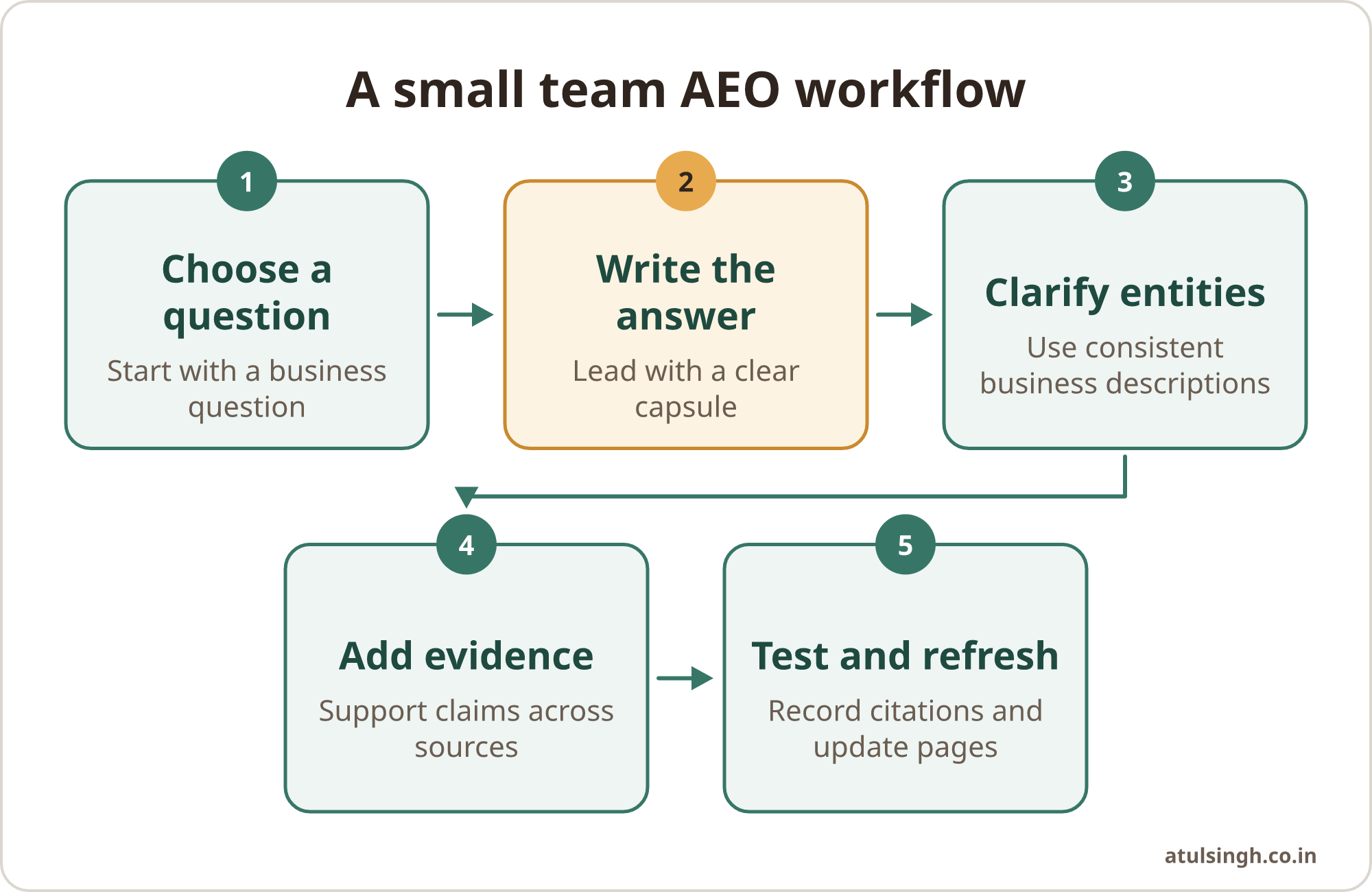
A five-step AEO workflow for small teams
1. Choose a narrow question with business value.
Create a list from sales calls, support tickets, product feedback, search queries and conversations with prospects. Prioritise questions that affect trust, evaluation or implementation. “What is the best CRM?” is broad and unstable. “Can a ten-person agency use this CRM without a dedicated administrator?” gives the writer a clearer audience, context and decision to address.
A content gap workflow can help compare existing pages, competitor coverage and missing subtopics before writing. Use the content gap workflow when the team needs a structured way to find questions worth answering.
2. Write the direct answer first.
Use the question as an H2 where it sounds natural. Follow it with an answer capsule that defines the subject, answers the question and includes the relevant condition or limitation. Keep the language specific.
For example, a hypothetical customer support page could use this structure:
- H2: “How long does account migration take?”
- Answer capsule: “Account migration usually depends on the number of records, data quality and integration requirements. A small, clean dataset may be prepared quickly, while a complex migration needs mapping, testing and human review before launch.”
- Supporting sections: required data, preparation steps, common risks and who approves the final import.
The capsule should stand on its own. Avoid beginning with “It depends” unless the next sentence names the factors that determine the answer.
3. Clarify entities and relationships.
An entity is a recognisable person, organisation, product, service, place or concept. AI systems need to understand what your business is, what it offers, who it serves and how its products relate to one another.
Use the same company name, product names, category descriptions and service claims across important pages. Explain abbreviations on first use. Keep the description of your ideal customer consistent between the homepage, service pages, social profiles and third-party listings.
4. Add evidence and corroboration.
Support factual claims with primary documentation, transparent methodology, customer questions, product records or named expert input where appropriate. Separate your own judgement from a measurable fact. If a claim changes frequently, include a review date and explain how it was checked.
Evidence also exists outside your website. Consistent mentions on professional profiles, review platforms, LinkedIn, YouTube transcripts and relevant communities can help answer systems connect your name with a category and a set of claims. This means making accurate information available where customers already discuss the problem, rather than repeating marketing copy.
5. Test, refresh and record.
Create a small prompt set based on your priority questions. Run the same prompts periodically across the answer systems your audience uses, recording whether your business appears, which page is cited, what description is used and whether the answer is accurate.
Pair this with server log checks for relevant crawler activity, referral traffic and conversions assisted by AI referrals. Standard SEO tools do not provide complete native tracking for AI citations, so the record will be directional rather than exact (Studio Una, 2026).
The existing article review workflow is useful for the refresh stage. It helps the team check claims and figures before republishing a page that AI systems may continue to retrieve.
The page structure that makes answers easier to use
A small team can apply a repeatable structure to service pages, comparison pages, category pages and detailed help articles:
| Page element | What to include | Why it helps |
|---|---|---|
| Question heading | One clear customer question | Defines the retrieval task |
| Answer capsule | Direct answer near the top | Gives the system a usable passage |
| Entity definition | Who you are and what you provide | Removes category confusion |
| Supporting detail | Conditions, examples and process | Adds context and usefulness |
| Evidence | Sources, methodology or documentation | Makes claims easier to verify |
| Related questions | Adjacent concerns and objections | Covers the decision journey |
| Review note | Owner and next review point | Keeps important information current |
Use short paragraphs, descriptive subheadings and lists when they improve scanning. Keep important definitions out of decorative banners or images. If a page contains a comparison, state the criteria before presenting the options.
For sales content, answer questions about fit, implementation, integrations and limitations. For marketing content, define the category and distinguish your point of view from general advice. For customer support content, state the resolution path, eligibility conditions and escalation point.
A marketing team that publishes ten pages with the same vague positioning will create more volume without much clarity. A smaller set of pages with consistent entity descriptions and useful answers gives the team a better base for ongoing review. The AI marketing workflow guide can help connect content refresh work to pipeline measurement.
Technical access and off-site consistency
Before changing copy, check whether relevant search crawlers can access the pages you want cited. A robots.txt file may block training crawlers while allowing search-specific crawlers, but the rules need careful review. Blocking OAI-SearchBot or PerplexityBot can prevent eligibility for citations even when the page performs well in conventional search (Studio Una, 2026).
Treat this as a deliberate policy decision. Some businesses may restrict training access because of intellectual property concerns while allowing search access. Know which crawler each rule affects and document the decision for whoever maintains the website.
Then review how your business appears away from its own domain. Check whether your company name, product names, category and audience are described accurately on profiles, directories, review platforms, public videos and relevant community pages. Correct contradictions where you control the source. Do not manufacture reviews or post repetitive claims in communities.
Perplexity has also created a Publishers' Program that shares advertising revenue with participating publishers when their content is referenced in user interactions (Perplexity, 2024). The wider lesson for small teams is that citations sit within an evolving publishing ecosystem. Useful, attributable content can have value beyond a conventional search result.
What to measure when citations are hard to track
Avoid treating citation count as the only success measure. A citation can be visible but irrelevant, or accurate but disconnected from a business outcome. Track a small set of signals that the team can review consistently:
- Prompt visibility: whether the business appears for a defined set of customer questions.
- Citation quality: whether the cited page is the intended page and supports the claim made.
- Entity accuracy: whether the answer describes the company, product and audience correctly.
- Referral activity: visits from AI systems, where analytics can identify them.
- Assisted outcomes: enquiries, sign-ups or support resolutions where an AI referral or self-reported discovery path is present.
- Content health: pages with outdated claims, broken sources or unclear ownership.
Keep a simple monthly or fortnightly log. Record the prompt, system, date, answer summary, cited URL, accuracy issue and next action. Sampling gives you a practical view of movement even when complete attribution is unavailable.
Remember that ChatGPT does not browse the web for every prompt. An analysis reported that live web search was enabled for 34.5% of queries as of February 2026, which means some responses rely heavily on pre-trained information rather than a fresh page retrieval (Onely, 2026). A page update may therefore take time to appear in answers, and some prompts may never produce a live citation.
Common mistakes and practical limits
Writing for an imaginary algorithm. Overusing keywords, forcing awkward headings or producing thin answer capsules can reduce usefulness. Write for the customer question first, then make the structure clear enough for retrieval.
Putting the answer too far down the page. Long introductions, brand history and broad context can push the useful passage away from the opening section. Lead with the answer and add relevant detail afterwards.
Changing the company description everywhere. Small wording differences can create uncertainty about what the business does. Maintain a short approved description, product glossary and list of claims that need evidence.
Ignoring recency. Perplexity can show strong recency bias, and older pages may lose visibility over time. Set a review cadence based on risk and change rate. Pricing, availability, regulations, integrations and product instructions deserve more frequent checks than stable educational definitions.
Blocking the wrong crawler. An attempt to opt out of training can accidentally restrict search access. Review robots.txt changes with the person responsible for site operations and test the result.
Expecting one page to win everywhere. ChatGPT, Perplexity and Google AI Overviews use different retrieval systems and source selections. Build a consistent evidence base, then test each system separately.
Automating judgement-heavy publishing. AI can help extract questions, draft structures and identify contradictions. A person should still review claims, sensitive advice, customer promises and anything that could affect reputation or revenue.
Where to start on Monday
Choose one commercial question that appears regularly in sales or support conversations. Interview the person closest to that question, collect the current evidence, write the answer capsule and publish a page with a clear owner and review date.
Next, check the page's entity description, internal links, source quality and crawler access. Add one or two accurate off-site references where your audience already looks for information. Run a small prompt sample before the change and again after the page has had time to be discovered.
Keep the first cycle narrow. A ten-person agency, software company or support team can learn more from improving one high-intent page and measuring it carefully than from producing a large batch of generic articles. The AI-first small business guide provides a broader way to connect this work to owned workflows and human review.
If you want a practical review of one content or customer workflow, you can book a workflow review call to identify where AI can realistically assist and where human judgement should remain in control.