
Your chatbot gives information that contradicts your marketing when the two systems are working from different versions of the truth. A campaign page may show a new offer, while the chatbot still retrieves an older promotion, policy document or discount code from its knowledge base.
The practical fix is to give marketing, support and the chatbot one approved source for offers and claims. Then add a change checklist to every campaign launch, test the important customer questions, synchronise the bot's knowledge and send uncertain cases to a person.
The short answer: separate content creates conflicting answers
A marketing campaign usually changes several things at once: the headline claim, price, eligibility rules, dates, exclusions, refund terms and call to action. These details may be spread across a campaign brief, website page, email platform, sales enablement folder, support articles and chatbot index.
If each team updates its own copy, the chatbot can answer from an older document even when the website has been corrected. A retrieval-augmented generation chatbot can find relevant content, but relevance does not guarantee that the content is current or that it contains the final commercial rule.
The risk is higher when a chatbot is allowed to improvise around exact terms. Pricing, availability, eligibility and refunds require controlled data and clear escalation rules. The language around an offer can be flexible, while the conditions of the offer should be treated as structured, approved facts.
A useful starting point is a messaging alignment audit across the website, campaigns, sales material and support content. The product messaging alignment audit can help identify conflicting claims before they reach the bot.
Why the gap matters to marketing and support leads
A contradiction creates more than an awkward customer conversation. It can lead to a support case, a missed sale, an incorrect refund expectation or a complaint about misleading information. The customer sees one company, even when several internal systems produced the answer.
In February 2024, the British Columbia Civil Resolution Tribunal found Air Canada liable for negligent misrepresentation after its website chatbot gave inaccurate bereavement fare refund information that conflicted with the published policy. The tribunal rejected the idea that the chatbot was a separate entity responsible for its own statements (Air Canada Chatbot Ruling 2024, 2024).
That decision is a useful operational warning. A disclaimer beside a chatbot does not remove the need to govern what the chatbot says when a customer could reasonably rely on the answer. The same principle applies to marketing claims, especially when a bot repeats a promise about savings, results, delivery or service coverage.
The Federal Trade Commission has also warned that AI-powered claims must work as advertised, with businesses responsible for false, misleading or unsupported representations made through automated tools (FTC guidance on AI claims, 2023). Marketing and support leads therefore need a process that controls both the campaign copy and the automated answer.
A consistent customer experience also protects internal capacity. When the bot gives a different answer from the campaign, support agents must investigate which version is correct, explain the discrepancy and often make a manual exception. A governed source reduces that avoidable work.
Build one source of truth for offers and claims
A single source of truth does not have to mean a large enterprise platform. For a small or mid-sized business, it could be a controlled table, a content management record or a shared knowledge repository with clear owners and revision history.
The important feature is the lifecycle. Each offer or claim needs an owner, an approval status, a start date, an end date, applicable products or audiences, exclusions, supporting evidence and the customer-facing wording that has been approved.
Use separate fields for rules and copy. For example, store the discount as a defined value, the eligible product as a defined item and the expiry as a date. Keep the approved explanation beside those fields. This gives the chatbot reliable facts while allowing marketing to write readable sentences around them.
A practical record might contain:
| Field | What to store |
|---|---|
| Claim or offer name | A unique internal name |
| Customer wording | The approved public statement |
| Eligibility | Who or what qualifies |
| Valid dates | Start and end dates |
| Exclusions | Products, regions or cases excluded |
| Evidence | Policy, product data or approved source |
| Owner | Person responsible for changes |
| Status | Draft, approved, live or retired |
| Bot instruction | Answer, qualify or escalate |
Marketing, product and support should agree on who can approve changes. A campaign manager may own the wording, while a support lead confirms that customers can be served according to the advertised terms. Someone should also own retirement, because expired content can remain available in uploaded documents or search indexes.
Where the source supports more than one system, give each item a stable name or identifier. That makes it easier to find every related landing page, email, support article and chatbot instruction when the offer changes.
Use a campaign launch change checklist
Every campaign launch should create a small operational change, not just a publishing task. The checklist should be completed before the campaign becomes visible and again when it ends.
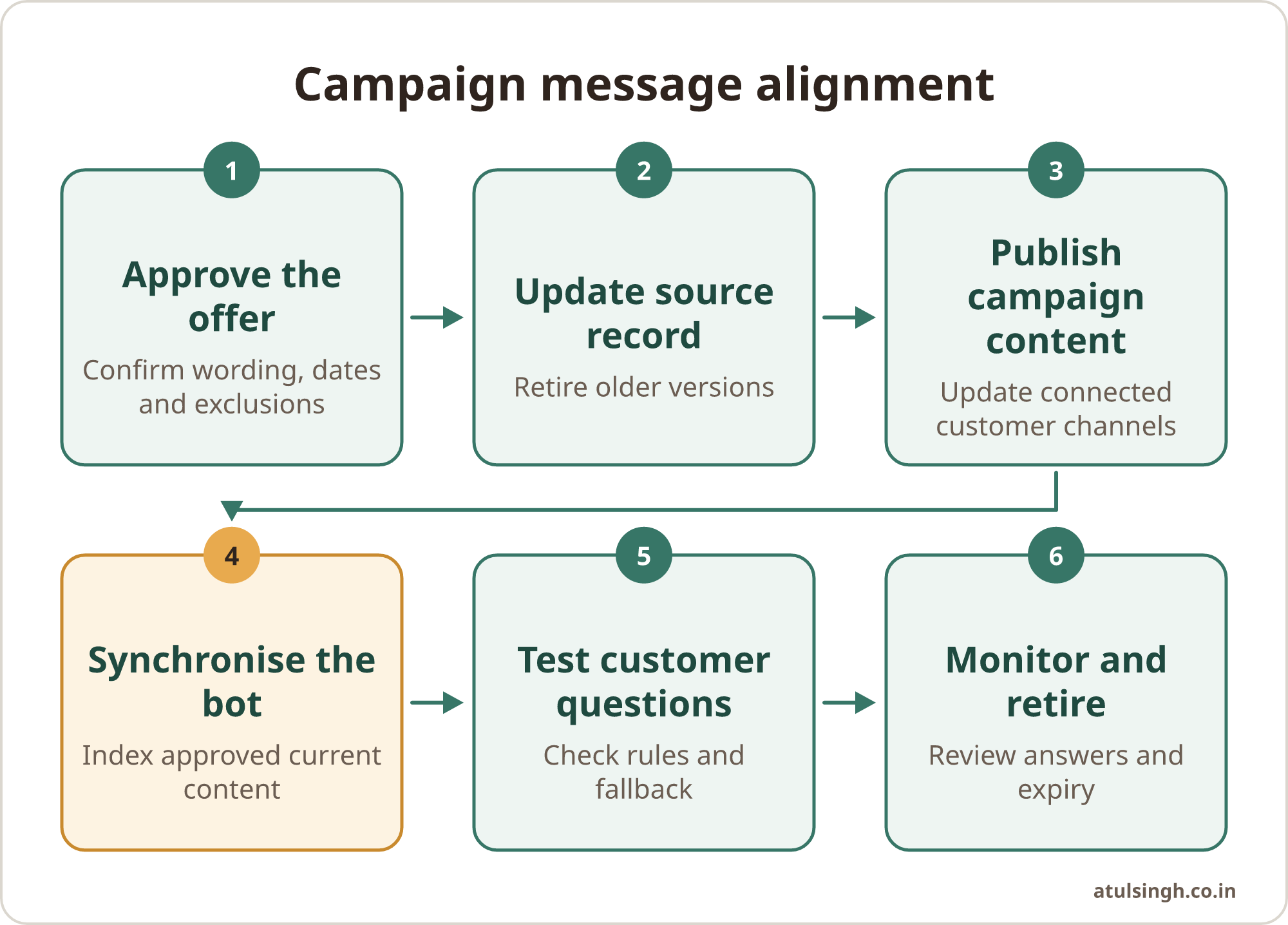
1. Freeze the final offer. Confirm the headline claim, price, dates, eligibility and exclusions. Remove draft language from the approved source and record who signed off the final version.
2. Update the shared record. Add the live offer to the source of truth and mark older versions as retired. Do not leave several active versions with similar wording, because retrieval systems may select the wrong one.
3. Update connected content. Check the landing page, email copy, paid advertising, social copy, sales documents, support articles and chatbot instructions. A campaign brief can help the agency and design team work from one message, especially when several people are publishing related assets. The shared campaign brief workflow is useful for this handover.
4. Synchronise the knowledge base. Trigger the approved update, confirm that the new content has been indexed and remove or archive deprecated documents. AWS documents incremental synchronisation for knowledge bases because changes in source repositories need to reach the retrieval index (Amazon Bedrock data source synchronisation, 2026).
5. Run benchmark questions. Ask the chatbot the questions customers are likely to ask, including a direct offer question, an eligibility question, an exclusions question and an expiry question. Test different wording, spelling and short follow-up questions.
6. Check the fallback. Create a route to a support agent for exceptions, ambiguous eligibility, complaints, refunds or any answer that depends on a customer record. The bot should explain what it can confirm and what a person needs to review.
7. Monitor after launch. Review conversations for repeated confusion, unsupported promises and questions the bot cannot answer. If the campaign changes during its run, repeat the relevant steps rather than editing one channel in isolation.
The sequence can be represented as a small release process:
- Approve the offer
- Update the source record
- Publish campaign content
- Synchronise the bot
- Test customer questions
- Monitor and retire
The change checklist should be short enough to use on a busy Monday. A long policy document that nobody follows will not protect the customer experience.
Make the chatbot follow rules, not just documents
Source documents are useful for explanations, background and approved wording. They are less reliable for exact commercial decisions when the answer depends on dates, product codes, customer status or several exclusions.
Use deterministic rules for the parts that can be expressed clearly. For example, the bot can check whether the current date falls within the offer period, whether the customer is asking about an eligible product and whether a required condition is present. If the available information is incomplete, the next action should be clarification or escalation.
Keep the answer grounded in the approved record. The bot should be able to identify the source or version behind a sensitive answer, at least in internal logs. Support leads can then review why a response was given and correct the source rather than repeatedly editing the bot's wording.
RAG can reduce unsupported answers by retrieving relevant material, but it does not remove the need for rules or human judgement. The grounding pattern should include approved sources, conflict handling, confidence thresholds and a human route for high-risk cases (Chatbot flow design grounding patterns, accessed 2026).
Set explicit guardrails for sensitive topics. The chatbot should escalate questions about refunds, legal rights, complaints, account-specific eligibility, unusual discounts and promises that are not present in the approved record. It should never fill a gap by inventing a condition or extending an offer because the customer appears ready to buy.
Brand consistency matters as well as factual consistency. A campaign may use a particular product name or approved claim, while the bot uses older terminology. A brand voice guardrail can help keep the wording consistent, but it should sit alongside offer governance rather than replace it.
Test the whole customer journey
Testing only the chatbot interface misses many causes of contradiction. Test the journey from campaign impression to customer question to support handoff.
For marketing, compare the advert, landing page, checkout language and confirmation message. Check that each uses the same offer name, dates, price and qualification rules. If a claim depends on evidence, confirm that the supporting material is current and approved.
For sales, test the questions a prospect may ask after seeing an advert. A hypothetical ten-person agency might advertise a fixed-price discovery package, while its chatbot still describes the old package structure. The test should ask about inclusions, availability, cancellation and what happens after the first call.
For support, test policy questions and edge cases. A customer may ask whether an offer applies to an existing subscription, whether two discounts can be combined or whether a missed deadline can be extended. These are the questions that need precise rules or a human decision.
For operations, test the update path itself. Change a harmless piece of campaign wording in a staging environment, trigger synchronisation and confirm that the chatbot retrieves the new version. Then retire the old content and check that it no longer appears in responses.
AWS notes that synchronisation can involve a processing window, so a source change may not be available in the chatbot immediately (AWS knowledge base synchronisation documentation, accessed 2026). Schedule updates before launch, display a temporary human handoff when necessary and avoid changing important terms at the last moment without testing.
You can also automate a copy review before publication. The marketing copy checking workflow can help identify outdated product terms, incorrect claims and brand rule violations before content reaches customers.
Common mistakes and sensible limits
Uploading every document. More documents do not automatically produce better answers. Archive obsolete promotions, label drafts clearly and restrict the bot's sources to approved material.
Editing the chatbot prompt after every campaign. Prompt edits can hide the real problem when the source record and content lifecycle are unmanaged. Update the governed offer record first, then use instructions for behaviour such as escalation and tone.
Trusting a disclaimer. A disclaimer may set expectations, but it cannot make an inaccurate offer safe. The business still needs reasonable controls over customer-facing representations.
Testing only the happy path. Ask about exclusions, expired offers, partial eligibility and unclear wording. A bot that answers the easy question correctly can still create risk on the question that affects a refund or purchase decision.
Relying on instant synchronisation. Indexing and cache updates can take time. Build a release window into the launch plan and have a manual fallback for the period between publication and confirmed synchronisation.
Giving every team equal editing access. Shared ownership works when responsibilities are clear. Limit who can approve live claims, record changes and retire content, while giving support a straightforward route to report errors.
Measuring only containment. A high rate of automated conversations does not prove that answers are correct. Review factual accuracy, escalation quality, repeated questions, complaints and cases where the chatbot and campaign used different terms.
Where to start on Monday
Choose one active offer that creates regular questions. Write down its approved wording, rules, dates, exclusions, source owner and escalation route. Then find every place where the offer appears, including the chatbot's indexed documents.
Next, run five to ten realistic questions through the bot and compare each answer with the approved record. Fix the source or rule that caused the discrepancy, synchronise the knowledge base and repeat the test. Keep the results in the campaign record so the next launch has a starting point.
For ongoing control, hold a short marketing and support review before each campaign goes live. Review new claims, retiring claims, likely customer questions and any changes that require human handling. This gives the team a repeatable operating habit without creating an enterprise-sized process.
If the current systems are fragmented or the chatbot needs a governed knowledge and escalation workflow, AI chatbot development can provide a done-for-you system build around your approved content, rules and support process.