
Use AI to prepare for a discovery call in three short blocks: research the account, turn the evidence into two or three hypotheses, then choose a small set of questions to test them. Spend five minutes on each block and arrive with a point of view, a few relevant questions and clear boundaries around what you will leave out.
The aim is to improve the quality of the conversation. AI can summarise public business information and help you spot possible friction, while your judgement decides what is credible, relevant and appropriate to discuss. The buyer should still do most of the explaining.
Why a short preparation routine works
Sales preparation often expands into tab-hopping. You check the company website, search for announcements, scan job postings, review the CRM and collect more information than you can use. A short routine gives you enough context to form useful questions without preparing a dossier that encourages you to lecture.
This matters because sales representatives spend nearly 60% of their time on administrative tasks, data entry and manual research, according to Salesforce's global survey of 5,500 sales professionals (Salesforce, 2024). A repeatable workflow helps reclaim some of that preparation time while keeping the important decisions with the seller.
Buyers also arrive with more independent research. Gartner's reported research says B2B buyers consult an average of seven information sources before meeting sellers, while 69% still turn to a sales representative to validate and contextualise what AI-assisted research has surfaced (Gartner research summary). Your preparation should therefore help you add context and judgement, rather than repeat information the buyer already knows.
The 15-minute AI routine
Use a generative AI tool that can work with the public sources you provide. Give it the company website, a recent annual report or investor update where relevant, public press announcements, selected job postings and useful CRM notes. Avoid pasting confidential customer information, private personal data or material covered by a non-disclosure agreement.
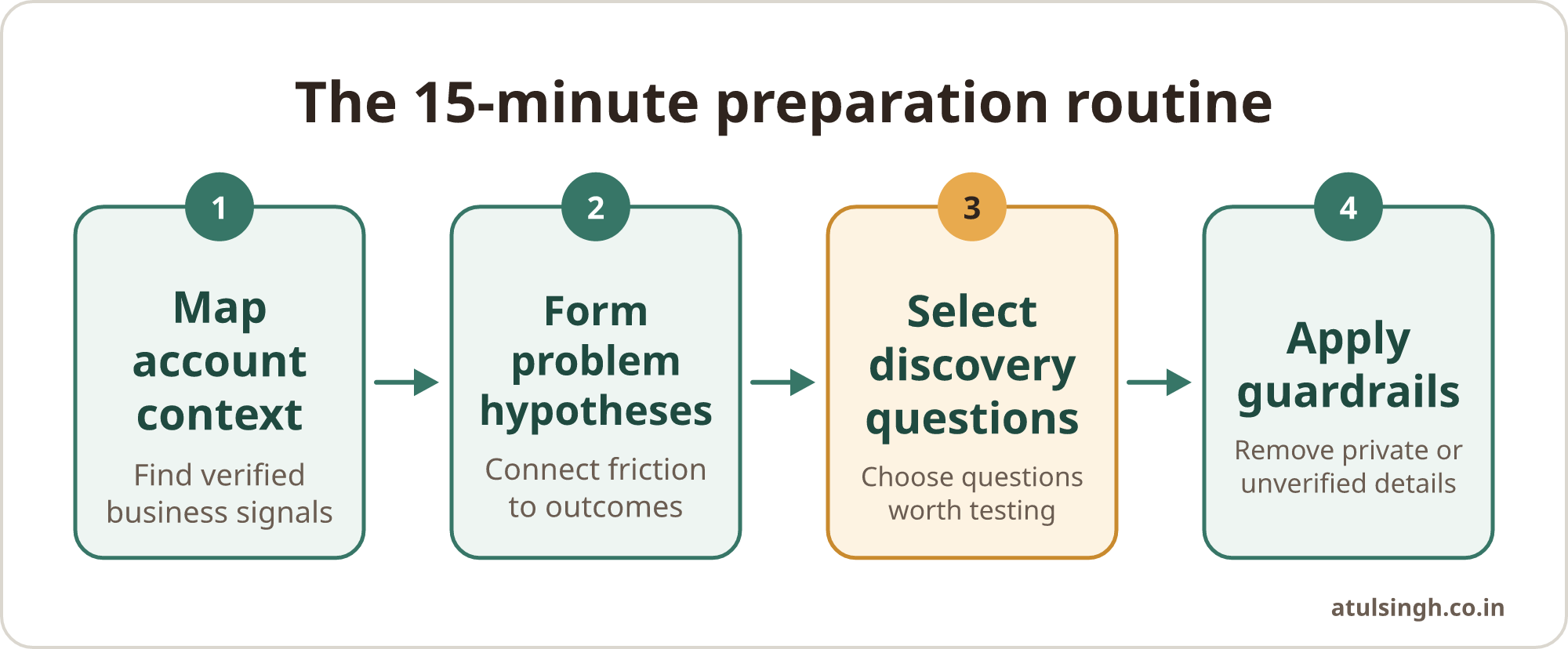
Minutes 1 to 5: map context and friction
Start with a compact research prompt. Ask the AI to separate confirmed facts from reasonable inferences and to include the source for every factual claim.
I am preparing for a discovery call with [company] and [role].
Using only the sources below, summarise:
1. Current business priorities
2. Relevant hiring trends
3. Market or competitive pressures
4. Operational friction this role may face
5. Facts that require primary-source verification

Separate confirmed facts from inferences. Do not make claims about the person's private life.
Sources:
[ paste public URLs or approved notes ]
Look for business changes that could affect the buyer's work. Examples include expansion into a new region, a change in sales model, a new product line, a leadership transition or hiring for a capability the business did not previously need. These signals help you choose a useful line of enquiry, but they do not prove that a problem exists.
A workflow such as B2B demo call preparation can help organise public company news, job postings and technology changes before a call. Keep the output short. Three relevant signals are more useful than a long list of loosely connected facts.
Minutes 6 to 10: create testable hypotheses
Ask the AI to turn the research into two or three possible problems linked to the buyer's role. Each hypothesis should be specific enough to test and modest enough to be wrong.
Based on the verified context, create three testable problem hypotheses for a conversation with [role].
For each hypothesis, include:
- The business change behind it
- The possible operational friction
- The metric or outcome it could affect
- What evidence would confirm it
- What evidence would disprove it

Use cautious language. Do not present an inference as a fact.
A useful hypothesis connects a visible business signal to a possible commercial consequence. For example, a company moving to a hybrid sales model may experience inconsistent CRM handoffs between regions. That could affect pipeline visibility or forecast confidence, but the call must establish whether the issue exists, how serious it is and who owns it.
This approach follows a broader discovery pattern described by Harvard Business Review: analyse the core business challenge, identify related performance measures, find the stakeholders accountable for those measures, project possible outcomes and prepare a relevant opening conversation (Harvard Business Review, 2025). The AI helps organise the thinking. The seller still has to judge whether the hypothesis deserves airtime.
For a founder, the same method can apply to a first conversation with a potential customer. If a ten-person agency is hiring account managers while adding new service lines, a reasonable hypothesis might concern delivery consistency during growth. It remains a question to explore, not a conclusion to announce.
Minutes 11 to 15: choose questions and an opener
Ask the AI to write four to six open questions linked to the hypotheses. Then select the questions that can reveal business impact, current process, ownership, urgency and the buyer's preferred next step.
Write six open-ended discovery questions for [role].
The questions should test these hypotheses: [paste hypotheses].
Cover current process, business impact, affected teams, ownership, priority and desired outcome.
Avoid generic questions and avoid repeating the same idea.
Keep the wording conversational and suitable for a first call.
Treat these as a question bank rather than a script. Gong Labs analysed more than 519,000 B2B sales call recordings and found that top-performing account executives ask between 11 and 14 discovery questions during a call. Fewer than 11 can leave important pain undiscovered, while 15 or more can make the buyer feel interrogated (Gong Labs, 2021).
Your four to six prepared questions will sit alongside natural follow-ups. Spread them through the conversation instead of asking them as a block. Gong's analysis also found that top performers distribute questions across the conversation, allowing the discussion to develop rather than forcing a checklist.
A hypothesis-led opener can be simple: "Companies expanding across regions sometimes find that CRM handoffs become inconsistent. How is your team managing that transition?" This gives the buyer a relevant starting point and leaves room for correction.
You can use the discovery call question plan when you want a structured question set that turns initial research into a focused conversation.
What to mention, and what to leave out
Good research creates restraint as well as relevance. Mention information about the business that the buyer would reasonably expect a professional seller to review, such as a public company announcement, a stated strategic priority or a role-specific operational change.
Leave out personal social media updates, family information, non-work commentary, inferred personal behaviour and unverified rumours. Do not refer to a private profile simply because an AI tool found it. The buyer has agreed to a business conversation, not an audit of their personal life.
Personalisation can become harmful when it feels intrusive. Gartner's research on buyer sentiment reports that personalisation creates a negative experience for 53% of customers when it feels like surveillance, and those buyers are 3.2 times more likely to regret a purchase decision (Gartner research summary). Use business relevance as the filter.
Before the call, run every planned reference through three questions:
- Is the information public and reasonably relevant to this conversation?
- Can the primary source be checked quickly?
- Would the buyer understand why a professional seller reviewed it?
If the answer to any question is no, leave the detail out. You can still use it privately to guide broader research, provided it is reliable, lawful and appropriate for your organisation's policies.
A practical call-preparation checklist
Use this checklist before joining the meeting. It keeps the routine small enough for an account executive handling several calls and clear enough for a founder preparing without a sales operations team.
| Preparation check | What good looks like |
|---|---|
| Account context | Three verified business signals |
| Role context | Clear view of the buyer's likely responsibilities |
| Hypotheses | Two or three possible problems, each open to disproof |
| Business impact | A possible metric or outcome for each hypothesis |
| Questions | Four to six selected questions, plus natural follow-ups |
| Opening | One relevant observation and an invitation to correct it |
| Guardrails | No private details, rumours or unverified claims |
| Call posture | Ready to listen, probe and change direction |
The preparation is complete when you know what you are trying to learn. It is incomplete when you are still collecting facts without knowing how they could affect the buyer's work.
For inbound leads, tailored qualification questions can help connect the lead's stated interest with the first-call agenda. The same discipline applies: use the available context to form questions, then allow the buyer to supply the facts.
Examples across sales, marketing and support
For an account executive: Suppose a software company has recently opened roles in two new regions. AI can summarise the public expansion signals and suggest a hypothesis about inconsistent sales processes across territories. The call should then explore how the team manages handoffs, reporting and local variation before any solution is discussed.
For a founder: Suppose a growing services firm is hiring delivery staff while publishing several new service packages. A useful hypothesis could concern maintaining quality and visibility as work becomes more varied. Questions might cover how work is assigned, where delays appear and which outcome matters most to the owner.
For a marketing leader: Suppose a company has launched a new product category and is hiring content specialists. Preparation could focus on how the team chooses audiences, captures customer language and connects content activity to pipeline. Avoid assuming that more content is the problem until the buyer explains the current process and commercial goal.
For a customer support leader: Suppose a business is expanding its support coverage and adding new channels. Research may suggest a hypothesis about inconsistent answers or increased escalation volume. The conversation should examine contact reasons, handoff points, quality checks and the effect on customer experience.
These examples show why role context matters. The same company announcement can lead to different questions for sales, marketing and support because each team owns different processes and measures.
Where AI needs human judgement
AI-generated research can contain fabricated news, financial metrics, dates and reporting relationships. Check every fact you might mention against the primary source. If the source cannot be verified, remove the detail or describe it as an area to explore without claiming it is true.
Keep the buyer's answers ahead of the prepared plan. A rigid list can cause you to miss a new issue, repeat a question or move past a useful answer. When the buyer introduces an unexpected constraint, follow it with a relevant probe even if it takes you away from the original hypothesis.
Research depth also needs a practical limit. Some sales approaches recommend 45 to 60 minutes of account preparation, while newer conversational guidance favours a shorter routine that leaves more attention for listening (AI Sales Leader). The right duration depends on deal value, complexity, risk and the information already available. A 15-minute routine is a useful default for an initial conversation, not a rule for every account.
Keep an audit trail for repeatable team use. Save the prompt, approved sources, final hypotheses and selected questions in the CRM or a shared workspace. This makes coaching easier and helps the team improve the workflow without creating a large technology project.
Start with one repeatable workflow
Choose one discovery-call type and define the inputs before choosing a tool. For example, an account executive may provide a company URL, a role, three approved public sources and the CRM history from the last interaction. The output can be a short context summary, three hypotheses, six candidate questions and a guardrail check.
Review the output with a manager or peer for a few calls. Look for factual errors, generic questions, inappropriate personalisation and missed business implications. Update the prompt and the review checklist based on what the team actually needs.
Adoption improves when the routine fits the existing sales process. Link it to the calendar preparation step, keep ownership clear and make the final decision visible to a person. A small workflow that the team can run consistently will usually be more useful than a complex system that depends on one specialist.
If your sales team needs help building this kind of repeatable practice, the AI Accelerator for sales teams provides live training around prospecting, research, outreach and follow-up. The focus should remain on helping people use AI responsibly in the workflows they already own.