
A support bot should hand over to a human when the customer faces financial, legal, account or safety risk, shows clear frustration, repeats the same issue, or asks for something outside the bot’s approved scope. The customer should also be able to request a person without arguing with the bot.
The handover only works when the human receives the conversation history, customer details, reason for escalation and useful troubleshooting already completed. A bot that transfers an empty ticket simply moves the customer’s work to another queue. A good rule is simple: automate routine questions, keep judgement with people when money, trust or reputation is at stake.
Start with the handover decision
Treat handover as part of the support workflow, rather than as an exception added after the bot is built. For every task the bot may handle, define what it can answer, what information it may collect and the conditions that require human judgement.
A customer should have a visible route to a person at the beginning of the interaction. This matters even when the bot can answer many routine questions. Gartner reported that 87% of customers believe companies using generative AI for customer service should provide access to a human agent (Gartner, 2026).
The bot can ask a few sensible questions before transferring. It should explain what will happen, preserve the conversation and avoid making the customer prove that the issue deserves attention. If the customer selects human support immediately, route the request according to the team’s hours, queue rules and service commitments.
For website enquiries outside support, the same principle applies. An after-hours chatbot can capture the question and relevant details for the next working day, as long as it makes clear when a reply will come. A context-rich after-hours lead process can help sales teams apply this pattern to new enquiries without pretending that a bot can replace a timely human response.
Use four handover triggers
The most useful rules group around risk, emotion, money and repeat contact. These signals can work separately or together. A low-risk question may stay with the bot, while a routine-looking question should move to a person if the customer has already tried several times.
Risk: Transfer immediately when the request involves suspected fraud, account takeover, identity concerns, legal threats, regulated advice, personal safety or a decision with serious consequences. The bot may collect facts and provide approved next steps, but it should avoid making a judgement that belongs to a trained employee.
Emotion: Escalate when the customer expresses distress, anger, grief, fear or strong distrust, especially when the wording suggests that the issue is affecting their livelihood or wellbeing. A polite apology from a bot rarely resolves the underlying need for judgement and reassurance.
Money: Route billing disputes, refunds outside policy, disputed charges, cancellation threats, compensation requests and complex payment failures to a human. The bot can explain standard terms and collect transaction details, but a person should own exceptions and goodwill decisions.
Repeat contact: Escalate when the customer repeats the same question, rejects the answer, asks for a different explanation or returns after an earlier failed interaction. Repeated misunderstanding is a practical sign that the bot’s current path has failed, even when each individual message appears simple.
There is a commercial reason to take repeat failures seriously. Zendesk reports that more than half of consumers may switch to a competitor after one poor service experience, rising to 73% after multiple negative interactions (Zendesk, 2026). The exact trigger will vary by business, so define it with examples from your own transcripts and complaints.
Give the bot clear boundaries
A handover rule needs a boundary around it. “The bot answers simple questions” leaves too much room for inconsistent decisions. Write down the approved topics, restricted topics, required evidence and permitted actions.
For example, a support bot for a small online retailer might answer delivery times, explain the returns policy and check an order status. It should transfer a damaged-item claim that needs photographs, a refund outside the policy window, a charge the customer does not recognise or a request to change account ownership.
A software company may allow the bot to explain password reset steps and known service updates. It should route data loss, security concerns, contract disputes, repeated login failure and requests that require access to internal systems.
Keep the rules close to the workflow. A knowledge base built for AI support should state who owns each policy, when it was last reviewed and which questions require human approval. This helps the team update the bot when a policy changes instead of relying on general instructions that age badly.
A useful test for each proposed bot task is:
- Can the answer be checked against an approved source?
- Can the bot complete the task without making a judgement call?
- Would a wrong answer create financial, legal, security or reputational harm?
- Does the customer need access to a system or permission the bot does not have?
- Can the customer reach a human if the answer fails?
If the last three questions raise concern, make handover part of the normal path. The aim is a small, owned system that the support team can understand and adjust.
Pass useful context to the human
A human agent should receive enough information to continue the conversation without asking the customer to start again. This is a design requirement, not a nice addition.
The handover record should include the customer’s name or account identifier, contact details where appropriate, the full conversation transcript, the detected intent, relevant order or ticket references, actions already attempted, the bot’s reason for stopping and any urgency or risk flags.
Add a short summary in plain language. For example: “Customer disputes a duplicate charge from the latest invoice. They supplied the invoice reference and said the first explanation did not resolve the issue. No refund has been issued.” That gives the agent a starting point while leaving the original messages available for checking.
The bot should separate facts from guesses. “Customer stated that the card was charged twice” is different from “duplicate payment confirmed”. The first is a customer report. The second requires verification in a billing system.
Make ownership explicit. The ticket should enter a named queue with a priority reason, an expected response time and any required internal action. If another department must help, record that routing step rather than leaving the agent to discover it later. A support handoff workflow can make ownership visible when cases move between support, finance, engineering or onboarding.
Map the workflow from message to resolution
A reliable handover has a short sequence that the team can test. Start with the customer’s message, assess the request, decide whether the bot can continue, gather only necessary information, route the case and confirm ownership.
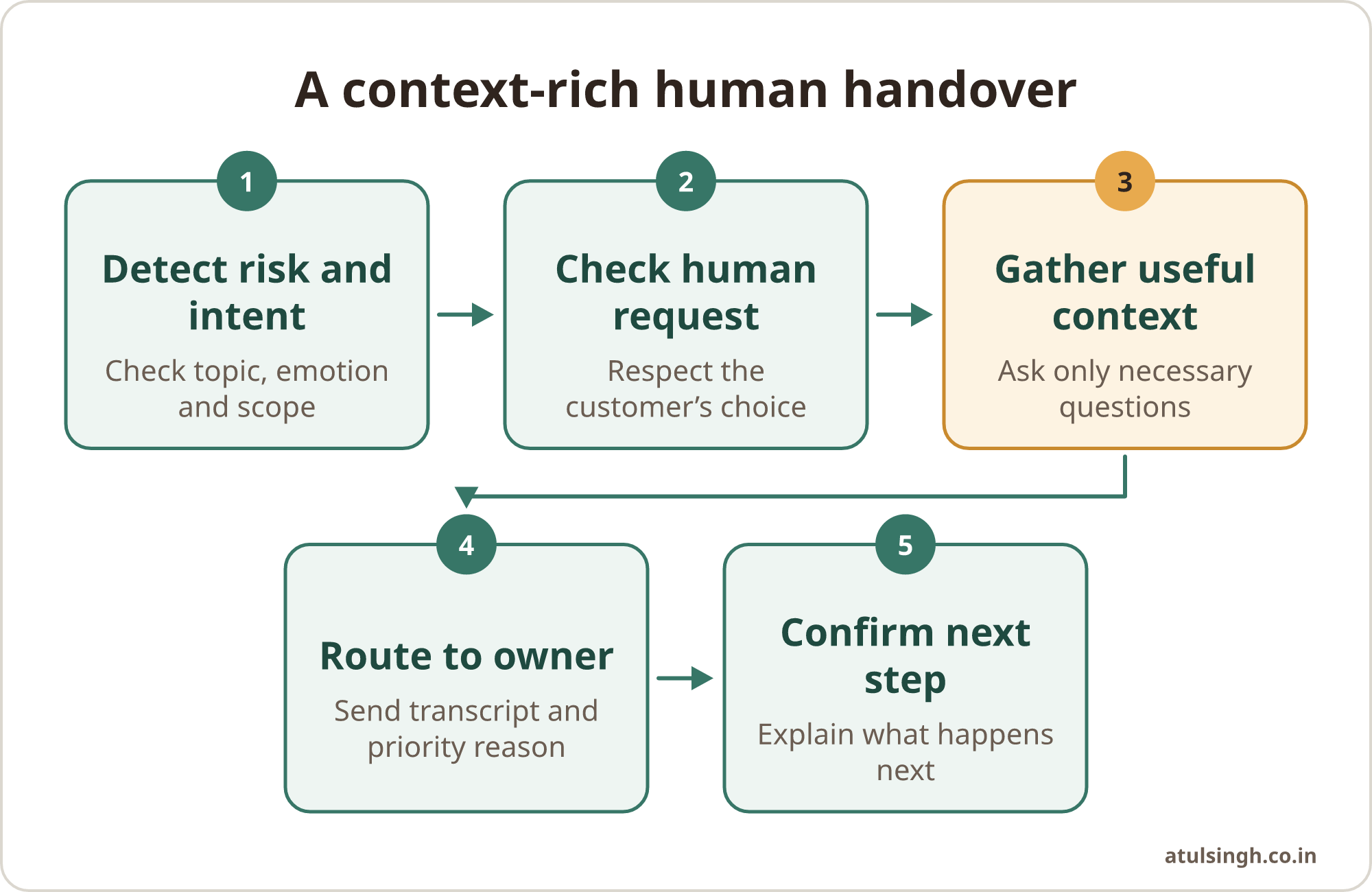
First, detect the topic and risk. Classify the request using the business categories that matter. Include risk flags for fraud, legal concerns, safety, personal data and financial disputes.
Next, check for a human request. If the customer asks for a person, respect that request. The bot can collect a short summary while the customer waits, but it should not create a maze of menus designed to retain the conversation.
Then, check the conversation history. Look for earlier contact, unanswered questions, contradictory information or repeated attempts. A return visit with the same problem should increase the chance of escalation.
After that, collect the minimum useful context. Ask for the order number, account email, error message or other details the agent actually needs. Avoid collecting sensitive information that the team cannot use safely.
Finally, route and confirm. Send the transcript and summary to the correct queue. Tell the customer what happens next, including whether the reply will arrive in the same channel or through another one.
The handover path should work during working hours, outside working hours and when the target team is unavailable. If no human is available, the bot should create a ticket or callback request rather than imply that a live conversation has started.
For a support team working across email and WhatsApp, build the same logic into both channels. An AI support assistant setup can help keep the boundaries, context fields and escalation language consistent.
A decision table for support leads
Use this table as a starting point, then adapt the examples to your policies and systems.
| Signal in the conversation | Bot action | Human context to pass |
|---|---|---|
| Standard policy question with a clear answer | Answer from approved content | Question, source used, customer identifier |
| Customer asks for a person | Offer or start handover | Customer request, transcript, current topic |
| Fraud, security, legal or safety concern | Transfer immediately | Risk flag, exact wording, account details, actions taken |
| Billing dispute, refund exception or compensation request | Transfer to the authorised team | Transaction reference, policy point, requested outcome |
| Anger, distress or loss of trust | Transfer with priority reason | Emotional signal, customer concern, previous replies |
| Repeated question or failed answer | Stop the loop and transfer | Earlier attempts, unanswered question, bot replies |
| Request outside the bot’s systems or scope | Explain the limit and route | Requested action, missing access, relevant identifiers |
Review the table with support agents before launch. They know which phrases indicate risk, which queues can approve exceptions and which details save time. The table should be short enough to maintain and specific enough to guide a consistent decision.
Avoid the common handover failures
The first failure is hiding the human option. Customers may accept self-service when it is convenient, but forced self-service creates friction and can make the bot feel like a barrier. Zendesk research found that 44% of consumers are frustrated when they cannot choose between a human agent and a chatbot at the start of a service interaction (CX Today, 2022).
The second failure is transferring without context. The customer then repeats the issue, the agent asks questions that were already answered and confidence in the whole support operation falls. The same Zendesk research found that 46% of consumers are most frustrated when they must start the conversation again after a chatbot handoff (CX Today, 2022).
The third failure is allowing the bot to continue after the boundary has been crossed. A bot that keeps guessing through a billing dispute or security concern can create a larger problem than an early transfer. Set a clear stop condition and make it visible in the ticket.
The fourth failure is measuring only containment. A high percentage of conversations ending with the bot may hide repeat contacts, abandoned chats, poor customer sentiment or avoidable complaints. Review escalated conversations, failed answers and repeat contact together.
A support lead should sample handovers regularly and ask whether the reason for transfer was correct, whether the context was complete, whether the right queue received the case and whether the customer had to repeat anything. Feed these findings into the bot’s content and routing rules. Reviewing failed chatbot conversations can make this work routine rather than occasional.
Start with one narrow support journey
Choose one repetitive journey with a clear owner, such as order status, appointment changes, password resets or delivery questions. Map the safe answer, the information required, the handover triggers and the destination queue before choosing a platform or writing prompts.
Write sample conversations for ordinary requests, ambiguous requests, angry customers, repeat contacts, payment disputes and requests for a person. Ask support agents to mark where they would take over and what they would need in the ticket.
Launch with a visible human route and monitor the complete journey. Look at bot resolution, handover reasons, repeat contact, missing context, queue ownership and customer complaints. Review the rules after the team has enough real conversations to identify gaps, without treating early performance as a permanent verdict.
A chatbot is useful when it removes routine work while helping the support team deal with sensitive cases sooner. Keep the system small, document the boundaries and make the handover easier than repeating the problem. If you want help designing that workflow, book a practical AI workflow review to examine one support process and decide what should be automated and where human judgement should remain.