
AI can qualify inbound leads by collecting missing information, checking firmographic fit, identifying buying intent, summarising conversations and routing each lead to the right next step. The safest workflow combines clear rules, AI assistance and human review instead of allowing a model to make every decision alone.
Start with data the system can verify, such as company details, job role, pages visited, form answers and previous conversations. Let a salesperson handle sensitive context, unusual buying situations, strategic accounts and any lead near the qualification boundary. The aim is faster and more consistent triage without rejecting a promising opportunity because the data is incomplete.
The short answer: qualify evidence, then route it
Inbound qualification usually asks two separate questions. First, does this account or person fit the business you serve? Second, are they showing enough intent to justify attention now? Keeping these questions separate produces clearer decisions than one combined score.
A useful workflow captures the lead and its source, checks fit against agreed rules, interprets intent signals and sends the record to a suitable queue. A human then reviews high-value, ambiguous or sensitive cases before a final sales decision.
AI can handle repetitive work. It can extract a company size from a form or website, identify the contact's role, summarise what they asked, spot unanswered questions and draft a follow-up. The output should be a recommendation with reasons, such as “Strong service fit, clear project timing, budget unknown, needs human review.”
Why fit and intent need separate scores
Fit describes whether a lead resembles the customers your team can serve well. Relevant evidence might include industry, location, company size, role, use case, existing systems and the type of service requested. Some information can come from a form, while the rest may be enriched from approved public or first-party data.
Intent describes what the lead is doing. A pricing page visit, a request for implementation details, a reply to a follow-up or a meeting request can all provide useful context. A high-intent lead with poor fit may still deserve a quick human check, while a strong-fit account with weak intent may belong in a slower nurture path.
Marketing operations teams often separate these measures into a behavioural score and a firmographic grade. This helps prevent an active but unsuitable lead from outranking a good account that has only made an early enquiry (4Thought Marketing, 2026).
Set the definitions before choosing a tool. Decide which fields describe fit, which actions indicate intent, how recent an action must be, and what evidence is required before a lead is routed to sales. A useful starting rule is to use transparent calculations for the initial score, then use AI for interpretation and drafting. This keeps the business logic visible while helping with messy language and incomplete context (Pixelmojo, 2026).
What AI can answer from existing data
AI is most useful when the answer already exists somewhere in the available evidence. It can read a form submission, chat transcript, email reply, call summary, CRM history or approved company record. It should point to the field or message behind its conclusion so a salesperson can check the reasoning quickly.
Fit questions AI can assist with:
- What company does the lead represent?
- Which industry or customer segment does it appear to serve?
- What role does the contact hold?
- Does the stated use case match an available service?
- Which location or market does the enquiry concern?
- What information is still missing?
Intent questions AI can assist with:
- What problem does the lead want to solve?
- Has a timeframe been mentioned?
- Has the lead requested a price, demonstration or proposal?
- Which pages, documents or messages show active research?
- Has the lead responded to earlier questions?
AI can turn free-text answers into structured fields. A message such as “We need help before the next quarter because our team is handling enquiries manually” may be classified as a workflow problem with stated time pressure. Keep the original message attached, because the classification supports judgement rather than replacing it.
For leads arriving outside office hours, a chatbot can ask a small number of useful questions, answer basic service queries and create a handoff summary. A practical example is a website visitor explaining their business type, current process, desired outcome and preferred contact time. A separate guide covers after-hours chatbot lead capture with a morning review process.
What still needs a human
A human should review cases where the available data could give a misleading impression. That includes strategic accounts, referrals, existing customers, unusual industries, regulated work and leads with a clear need but an unfamiliar buying process.
People are also better placed to judge quality that is difficult to encode. A contact may have a modest job title but influence the purchase. A small company may have a complex need and an urgent deadline. A lead may use different language from the ideal customer profile while describing a problem the business can solve well.
Human review matters when the decision affects customer trust. A salesperson should decide whether a sensitive issue needs a personal response, whether a commitment can be made, and whether the stated problem is suitable for the service. AI can prepare the context and suggest questions, but the relationship owner should make the judgement.
Keep an explicit review queue for uncertain cases. Route a lead to a person when the fit score is strong but an important field is missing, when intent is high but the use case is unclear, or when the model gives conflicting reasons. When a lead skips qualification questions, use AI to identify what is missing and draft a polite follow-up. A workflow for checking missing qualification answers can reduce the chance that a busy inbox hides an incomplete but promising enquiry.
A practical inbound qualification workflow
Build the workflow in this order. Each stage should have an owner, a data source and a defined action when information is missing.
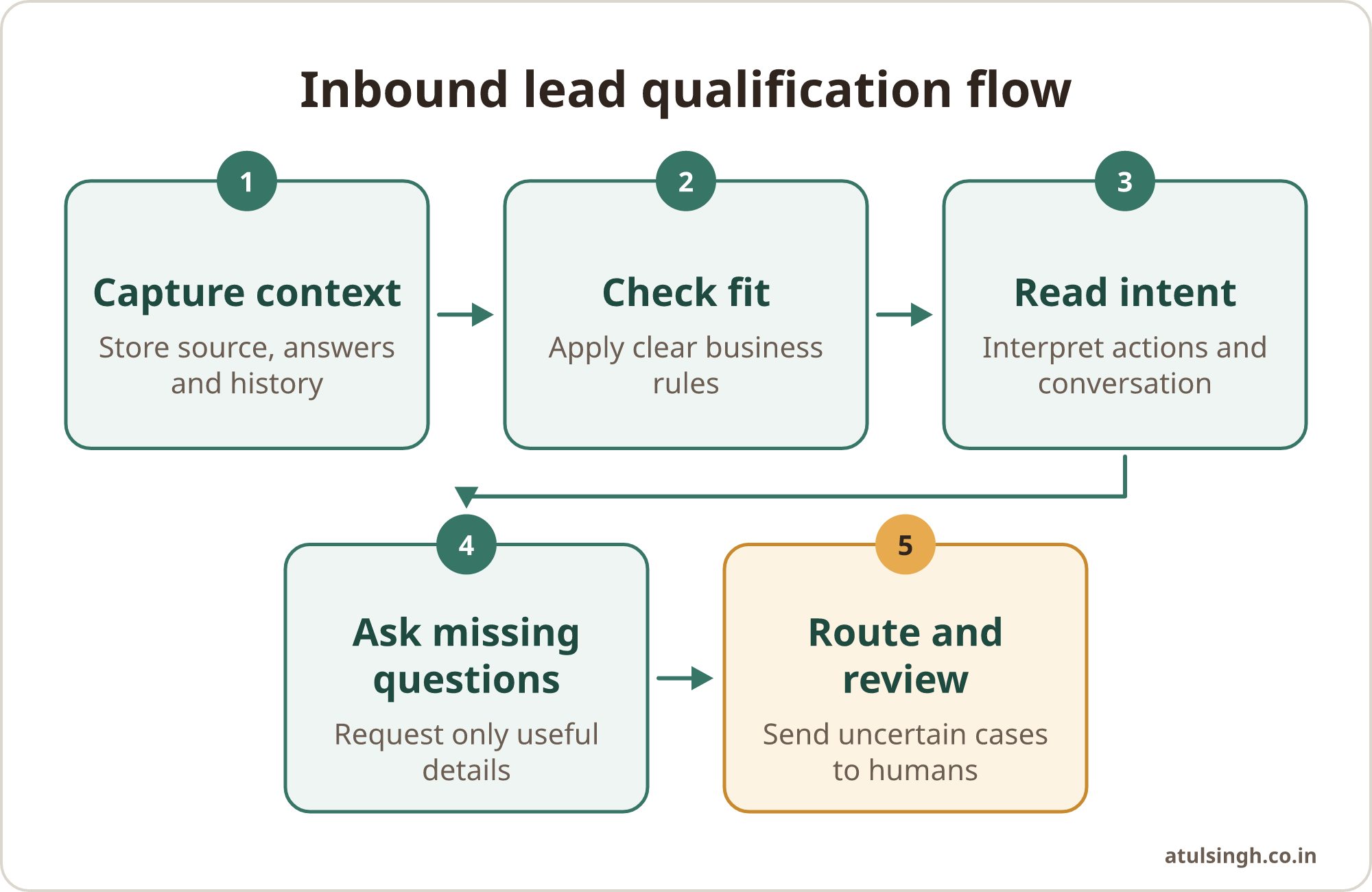
Capture the full context. Store the source, landing page, form answers, chat transcript, consent status and previous CRM activity.
Clean and normalise the record. Standardise company names, job titles, locations and duplicate contacts. Where a value is inferred, label it as inferred and preserve the original wording.
Calculate transparent fit signals. Use agreed rules for customer segment, service match, geography, company characteristics and contact role. Keep the rules simple enough for marketing and sales to inspect.
Add intent evidence. Record recent actions and conversation content. Give more weight to direct requests and clear problem statements than to a single anonymous page visit.
Ask useful follow-up questions. If budget, timing, decision process or use case matters, ask for the missing detail in plain language. Do not make a lead complete a long questionnaire before receiving a helpful response.
Route by urgency and confidence. Send clear opportunities to the appropriate salesperson, uncertain cases to human review, and relevant early-stage leads to nurture with a reason and future review condition.
Record the outcome. Capture whether the lead was accepted, nurtured, referred, disqualified or converted, along with the reason.
The sequence can run through a CRM, form tool, chat channel and automation platform. The particular tools matter less than clear ownership, reliable fields and a handoff the team can understand.
A decision guide for sales and marketing ops
Use the following guide when deciding what the system should do with each type of evidence.
| Lead evidence | AI action | Human action | Safe next step |
|---|---|---|---|
| Clear fit and clear buying need | Summarise and prioritise | Confirm ownership | Prompt sales follow-up |
| Good fit, incomplete answers | Find missing fields | Decide what to ask | Send a focused question |
| High activity, weak fit | Explain the mismatch | Check for an exception | Review before routing |
| Low activity, strong fit | Record account context | Decide nurture timing | Add to relevant nurture |
| Unusual need or sensitive topic | Flag uncertainty | Assess suitability and tone | Personal response |
| No clear fit or intent | Explain the evidence | Check for data errors | Confirm or nurture, never silently drop |
A low score can reflect a poor prospect, but it can also reflect a new market, an incomplete form, an unrecognised company or a buying signal the model has never seen. Use the score to set routing urgency, not as an automatic rejection mechanism.
For a ten-person agency, this might mean one shared review queue checked several times each day, with urgent leads assigned immediately and uncertain records reviewed by the sales lead. The system can draft the summary, but the team still owns the decision and the customer response.
Common mistakes that damage lead quality
Using dirty CRM data. Duplicate records, stale job titles and missing outcomes weaken any scoring system. Before adding AI, inspect recent records and agree which fields can be trusted.
Training only on closed-won leads. Historical wins can reflect the leads salespeople chose to work, which may exclude viable segments that were previously ignored. Review rejected, untouched and nurtured leads as well as closed opportunities before changing the rules.
Treating activity as intent. More page views do not always mean a buying decision is close. Consider the subject of the activity, its recency, the person involved and the conversation around it.
Asking too many questions at once. Qualification should help the buyer move forward. Ask the smallest set of questions needed for the next decision, then let the salesperson explore the rest in conversation.
Hiding the reasons behind a score. A sales rep should see which facts influenced the recommendation. Include source fields, quoted language, timestamps and confidence where possible.
Allowing automatic rejection. If the system cannot establish fit, send a confirmation, a clarifying question or a suitable nurture sequence. A silent discard removes the chance to correct bad data and can damage trust.
Failing to review outcomes. Compare recommendations with sales decisions and later pipeline results. Look for strong leads routed too slowly, industries scored unfairly, or repeated questions that forms should capture earlier. A lead quality audit can help organise evidence before changes are made.
Where to start on Monday
Choose one inbound source with enough volume to observe, such as a website form or shared sales inbox. Write down the qualification questions the team already uses, separate fit from intent, and label each answer as available, missing, inferred or uncertain.
Create a small routing table defining what counts as urgent, what requires human review, what belongs in nurture and who owns each queue. Keep the first version narrow. A system that handles one source reliably is easier to improve than a wide workflow that nobody trusts.
Test it on recent records without changing live routing. Ask two salespeople to review the summaries, identify incorrect assumptions and note which evidence they needed but could not find. Use those observations to improve the form, rules and prompts together.
Once live, review accepted, nurtured and rejected leads each week. Track response time, missing information, sales acceptance, meeting quality and reasons for override. The useful question is whether the workflow helps the team make better decisions with less routine work, while keeping space for judgement.
If the process spans forms, chat, CRM updates and human review, a free 30-minute workflow review call can help you look at one workflow and decide what, if anything, to automate. The scope should begin with one qualification workflow, clear guardrails and a handover that leaves ownership with your business.