
A human review of an AI output fails when the reviewer becomes a confirmation step rather than an independent decision-maker. If the person sees a fluent recommendation, has little time, lacks the right evidence or cannot overturn it, approval becomes the easiest action.
The remedy is to design review into the workflow. Route work by risk, show the evidence separately from the recommendation, ask for a judgement that can be audited, and sample approved outputs for quality checks. A review process should make rejection possible, expected and explainable.
The short answer: a check is not meaningful judgement
Many teams describe an AI workflow with a reassuring sentence: “A human checks the output.” That sentence leaves out the conditions that determine whether the check has any value. The reviewer needs enough time, relevant context, technical understanding and authority to change the result.
The UK Information Commissioner’s Office says a human review can still count as part of a solely automated decision when the reviewer simply rubber-stamps the system’s output. Meaningful review requires active assessment and a real ability to overturn the recommendation (Information Commissioner’s Office, 2019).
Approval fatigue develops when the queue is too large, the outputs look similar and the cost of disagreement feels higher than the cost of acceptance. Over time, the reviewer learns that the system is usually acceptable and starts treating each new item as routine. The review queue remains visible, while the judgement behind it becomes thinner.
This affects sales, marketing and customer support in different ways. A sales manager may approve AI-generated outreach without checking whether the claim fits the prospect. A marketing lead may accept a polished campaign draft without checking its offer, audience or evidence. A support lead may approve a reply that sounds helpful but gives an outdated policy answer.
Why human-in-the-loop workflows degrade
Automation complacency is a known human factors risk. NIST describes how prolonged reliance on automated systems can create a loss of situational awareness, leaving operators less ready to detect and handle failures when they occur (NIST, 2022). A reviewer who sees hundreds of acceptable outputs may pay less attention to the one unusual case.
Explanations do not automatically solve this. In a 2021 experiment with 199 participants, explanations shown alongside AI recommendations did not reduce overreliance on incorrect recommendations and could increase it. Participants often used quick cognitive shortcuts instead of examining the explanation carefully (Buçinca, Malaya and Gajos, 2021).
The order of information also matters. If the AI recommendation appears first, the reviewer’s task can become finding reasons to support or challenge that recommendation. Research on cognitive forcing functions found that eliciting a human judgement before showing AI assistance reduced uncritical compliance, because the reviewer had formed an independent view first (Buçinca, Malaya and Gajos, 2021).
The practical lesson is simple. Review design has to account for attention, sequence and workload, rather than assuming that a conscientious employee will remain equally alert throughout a large queue.
A recent example from software development illustrates the risk. In a 2026 controlled experiment involving more than 100 experienced developers, 94% failed to detect sabotage in AI-generated coding work because they approved commits without inspecting code differences. Even with an automated safety monitor and alerts, 56% still approved malicious code (Yu et al., 2026). The setting was technical, but the workflow failure is familiar: approval happened without independent inspection.
Design review around risk, evidence and authority
A useful review process answers four questions before the AI is introduced.
What could go wrong? Identify the consequence of an incorrect output. A misspelled subject line and an incorrect refund instruction do not belong in the same review category. Consider money, customer impact, privacy, legal exposure, reputation and the difficulty of reversing the decision.
What evidence should the reviewer inspect? Put source material, customer details, policy rules or campaign requirements beside the output. Keep raw evidence visually and operationally separate from the AI recommendation, so the reviewer can inspect the basis of the decision rather than accepting a convincing summary.
Who can reject or change it? Assign a named role with enough authority to stop the workflow. A reviewer who can only approve or send back an item for another person’s decision has limited control. For sensitive cases, define an escalation route and a response time.
What triggers deeper review? Route low-confidence, unusual or high-impact cases to a more careful queue. Routine, low-impact work may use sampling or automated checks, while exceptions receive full human assessment. NIST’s generative AI guidance supports risk-based review triggers, separation of evidence from recommendations and logging of go or no-go decisions (NIST, 2024).
A risk tier should change the amount and type of review. It should not merely add a label to an unchanged approval screen. If every item still receives the same rushed sign-off, the tiering has not changed the operating model.
A review workflow that resists rubber-stamping
The following sequence works for an AI-assisted draft, recommendation or classification. It can be implemented with a shared form, a workflow tool or a small internal application.
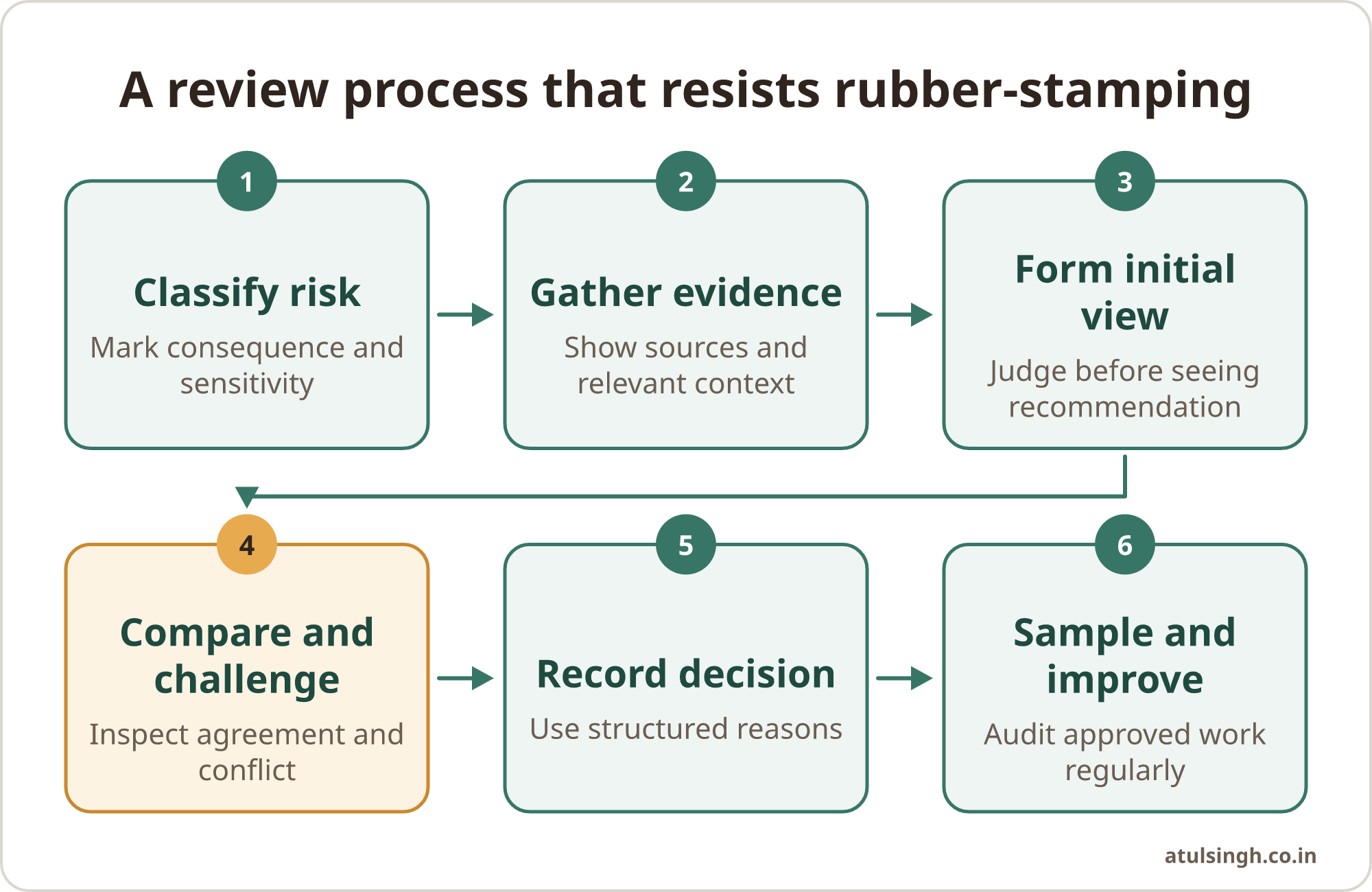
1. Classify the consequence. Mark the item as routine, material or sensitive. Use business language that the team already understands, such as “customer-facing”, “financial”, “personal data” or “reputation risk”.
2. Gather the evidence. Present the source record, applicable policy and relevant context before the recommendation. Remove irrelevant material that increases reading time without improving judgement.
3. Form an initial view. Ask the reviewer for a short independent assessment before revealing the AI suggestion where the decision warrants it. This could be a category, a pass or hold decision, or two facts the reviewer expects the output to contain.
4. Compare and challenge. Show the AI output alongside the evidence and require the reviewer to identify agreement, omission or conflict. For higher-risk items, require a deliberate inspection step rather than a single approve button.
5. Record the decision. Use structured reasons for approval, rejection, editing or escalation. A short reason code makes trends visible and reduces the temptation to write vague comments such as “looks fine”.
6. Sample the accepted work. Review a selection of approved items, including some from low-risk paths. Compare the original evidence, AI output and final decision, then update the workflow when recurring errors appear.
These steps add friction where it helps judgement. Cognitive forcing functions, such as independent assessment, active comparison and an inspection delay, have been shown to reduce overreliance on incorrect AI outputs, although they also reduce perceived usability and satisfaction because they require more effort (Buçinca, Malaya and Gajos, 2021).
A practical sequence is: risk classification, evidence review, independent view, AI comparison, decision reason, then sampling and improvement.
The purpose is to reserve deliberate review for decisions where a mistake matters, and to use sampling and monitoring for lower-risk work.
What this looks like in everyday teams
Sales: Say a ten-person agency uses AI to draft follow-up emails after discovery calls. Routine scheduling messages might pass through a light review, while pricing, delivery commitments and claims about previous results require the seller to check the call notes and approve specific claims. A reject taxonomy could include unsupported claim, wrong customer context, unsuitable offer and missing next step.
The manager should sample approved messages, not only the ones sellers reject. If the same type of claim appears repeatedly, the team can improve the prompt, source material or sales process. A workflow that records only approvals cannot show whether review is doing any work.
Marketing: Imagine a small business producing weekly campaign drafts with AI. The reviewer could assess the audience, offer, supporting evidence, brand risks and call to action before seeing the AI draft, then compare the draft against that assessment. A campaign that contains a factual claim or regulated product statement should move to a higher-risk queue.
For marketing teams, a clear rejection reason is more useful than a general quality score. “Needs work” does not tell the next person whether the issue was evidence, tone, targeting, compliance or an incorrect product detail. Teams that need a wider adoption plan can also review how roles and measures change in AI rollout workflow redesign.
Customer support: Suppose an AI assistant drafts replies using tickets, a knowledge base and account information. A support lead might allow sampling for ordinary status questions, while refunds, complaints, access problems and policy exceptions require full review before sending.
The reviewer should see the relevant policy source and the customer’s actual request. A reject code such as “policy mismatch”, “missing context”, “unsafe promise” or “tone risk” creates a useful feedback loop. A support team can apply the same principle when reviewing support ticket replies for coaching and quality control.
A practical control sheet for managers
Use this table to inspect an existing human review process. The questions are intended to expose a nominal check that has no practical power.
| Control | Weak arrangement | Stronger arrangement |
|---|---|---|
| Risk | Every output follows the same queue | High-impact and unusual cases receive deeper review |
| Evidence | Reviewer sees the AI answer first | Source records and policy are available independently |
| Timing | Review happens during a packed queue | Workload and time support a genuine assessment |
| Authority | Reviewer can only approve or forward | Reviewer can reject, edit, pause or escalate |
| Reasons | Free-text comments or no record | Structured reject and override reasons |
| Sampling | Only failed outputs are inspected | Approved outputs are sampled across risk paths |
| Monitoring | Managers track volume and speed | Managers track errors, overrides and recurring reasons |
Do not treat agreement rate as a success measure on its own. If every reviewer agrees with the AI almost every time, that may indicate a very accurate system, or it may indicate that the team has stopped examining the outputs. Compare agreement with sampled quality, override reasons and the consequences of detected errors.
A useful dashboard can remain small. Track the number of items reviewed, the number changed or rejected, the main reject reasons, the number escalated and the results of sample audits. Review the measures at a regular operating meeting and assign an owner for each workflow change.
Common mistakes and limits
Making explanations the main safeguard. A long rationale can sound authoritative while hiding a weak basis. Explanations should support evidence inspection, not replace it. Ask what source supports the recommendation and what would disprove it.
Sending everything to a person. A full manual queue creates fatigue and encourages fast approval. Risk-tiered routing is more credible than pretending that one person can examine every output with equal care.
Using confidence as truth. A model’s confidence signal can help route work, but it does not establish that the content is correct. Outliers, sensitive topics and missing context deserve attention even when the output sounds certain.
Giving reviewers responsibility without power. A person cannot provide meaningful oversight when targets reward speed, the evidence is unavailable or escalation is punished. Review capacity must be reflected in workload, permissions and performance expectations.
Ignoring architectural limits. Human vigilance has a ceiling. Regulators expect human oversight in relevant settings, while human factors research warns that high-throughput review can collapse into routine acceptance. Use approval limits, constrained actions, sampling, source checks and escalation paths so safety does not depend on attention alone.
For teams building more complex automations, it helps to stabilise the workflow before adding agents. The principles in operational engineering for AI agents cover exceptions, explainability and ownership in workflows where a simple review step is insufficient.
Where to start on Monday
Choose one AI-assisted workflow that already has a human approval step. Pick a recent batch of outputs and inspect five things: the consequence of an error, the evidence the reviewer saw, the time available, the decisions that can be reversed and the reasons recorded when work is changed.
Then introduce one risk distinction, one structured reject list and one sample audit. Ask reviewers to make an initial judgement before seeing the AI recommendation for the highest-impact cases. After a week or two of operation, compare the sampled outputs with the recorded decisions and remove any control that adds effort without improving judgement.
A review process earns trust when the team can show where people disagreed, why they disagreed and what happened next. If the workflow needs a closer inspection, a workflow review call can help identify where human judgement belongs and which routine checks can be handled more simply.