
Context engineering is the practice of giving an AI system the right information and instructions for a task before it produces an answer. That information can include the user's role, trusted source material, examples, rules, previous decisions, available tools and the required output format.
A practical context pack turns this into a repeatable team workflow. Instead of writing a clever prompt from scratch, you prepare a small set of maintained materials that tells AI what the team is doing, which sources to use, how to make decisions and what a useful result should look like.
The short answer: build a reusable context pack
Prompt engineering focuses on how you communicate with a model in one interaction. Context engineering focuses on the information the model can access while generating a response, including memory, retrieved documents, tool outputs and the wider information environment (Unrot, 2026).
For everyday work, a good prompt may be enough. A sales representative can ask for a follow-up email, a marketer can request campaign ideas, and a support adviser can summarise a ticket. Context engineering becomes more useful when the same type of work happens repeatedly and the answer depends on company knowledge.
A context pack for a sales call, for example, might contain the sales role, the ideal customer profile, product boundaries, approved claims, a discovery question example, relevant account notes and a short structure for the final brief. The person using it still checks the result and applies judgement, especially where pricing, commitments or customer relationships are involved.
Why this matters for working teams
Teams often begin with individual experimentation. Each person develops preferred prompts, saves useful chats and adds information when the model makes a mistake. That can work for simple tasks, but it becomes difficult to maintain when several people produce customer-facing or commercially important work.
One reported finding from DataHub's 2026 State of Context Management Report says that 82% of IT and data leaders agree prompt engineering alone is no longer sufficient to power AI at scale (Unrot, 2026). The useful lesson for a small business is practical: repeated AI work needs shared inputs and clear ownership, rather than a growing collection of private prompt tricks.
Context also affects adoption. If the model receives incomplete product information, old campaign guidance or inconsistent service policies, staff have to spend time correcting it. A shared context pack gives the team a common starting point and makes it easier to improve the workflow when a rule, offer or process changes.
Large pilots can fail for reasons that are visible in smaller organisations too. A Fortune article covering MIT's NANDA report found that around 95% of generative AI pilots at large companies were failing to deliver measurable return, with data quality, fragmented systems and weak governance among the reasons discussed (Memgraph, 2026). A small team does not need enterprise architecture to respond, but it does need clean source material, an owner and a defined use case.
For a broader way to connect AI skills to daily work, see the 4D AI fluency framework. It helps teams think about adoption and workflow design alongside tool knowledge.
The five parts of useful context
A context pack can be small. Start with five parts and add material only when it improves a real task.
1. Role. Explain who the AI is supporting and what that person is responsible for. A support adviser may need help resolving a case while protecting customer trust. A marketing manager may need a campaign brief that is clear enough for a designer to use.
2. Source material. Provide the documents, notes and records the task depends on. Identify which sources are authoritative, which are background reading and which should be ignored when they conflict with current policy. Source material may include a product sheet, service policy, customer notes, brand guidance or a meeting transcript.
3. Examples. Show one or two examples of acceptable work. Examples communicate judgement that is difficult to capture in a general instruction. Use real approved examples where permission allows, and remove personal or confidential information before sharing them.
4. Rules. State the boundaries clearly. These might include approved terminology, claims that require evidence, information that must be escalated, personal data handling, or situations where the AI must say that it does not have enough information.
5. Output format. Describe what the finished result should contain and how it should be structured. A sales brief might use headings for account situation, likely priorities, evidence, discovery questions and open risks. A support summary might separate the customer's issue, actions taken, proposed response and escalation status.
Anthropic describes context engineering as curating and maintaining the optimal set of information during model inference, including information that enters the context outside the prompt itself (Anthropic, 2025). That definition matters for non-technical teams because the work includes maintaining the source material, examples and rules, not just improving wording.
Build a context pack on Monday
Choose one recurring workflow before you build anything. Good candidates include preparing for a sales call, turning a product specification into a campaign brief, summarising support tickets or drafting a weekly performance update. Select a task with a clear owner and a result that someone already reviews.
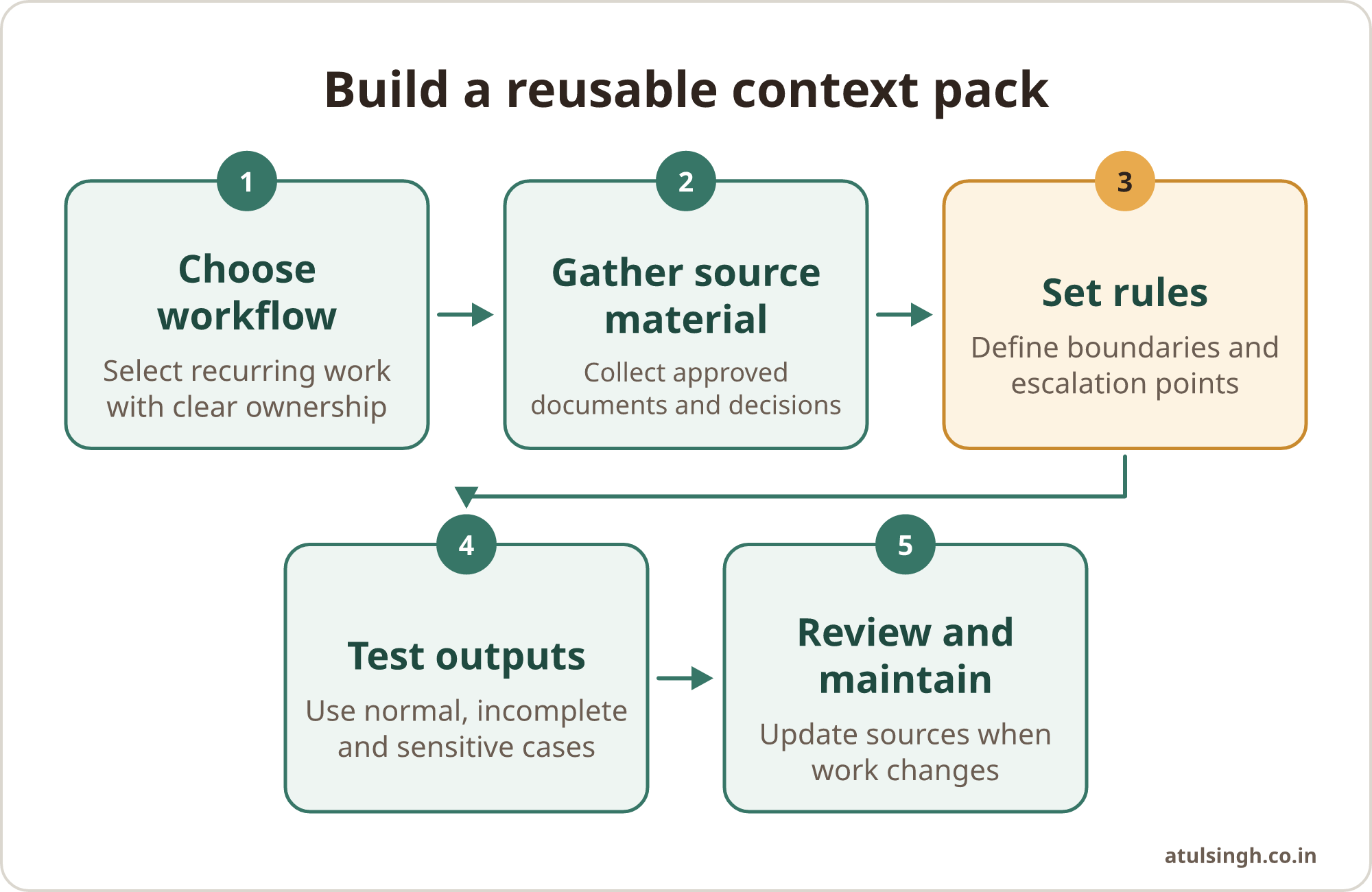
Start with the last few approved outputs, the documents people actually use and the decisions that often cause confusion. Ask the person doing the work what they check before sending the result. Those checks usually reveal the context that a generic prompt leaves out.
Use a simple root document in a shared location. A short Markdown file can keep the instructions readable and easy to update, while supporting documents can remain in their normal shared locations. Keep the main file short, then link to supporting documents rather than copying every policy and archive into every interaction.
Write the pack in this order:
- Purpose and role: what task the pack supports and who owns the decision.
- Trusted sources: where the relevant facts come from and which version matters.
- Working rules: what the AI must follow, avoid, flag or escalate.
- Examples: one good output and, where useful, one example of a common mistake.
- Output structure: the headings, length, tone and required evidence.
- Review date: when the owner checks whether the pack is still accurate.
Test the pack against several normal cases and one awkward case. For sales, the awkward case could be an account with incomplete information. For marketing, it could be a brief with a claim that the source material does not support. For support, it could be a request that should be escalated rather than answered directly.
A useful workflow should make review easier, rather than hide it. If the AI produces a draft, include a short checklist for the human reviewer. That checklist might ask whether every claim has a source, whether customer details are handled correctly and whether the output follows the approved format.
The process can be represented as a simple sequence:
Use the sales call brief builder as a starting point for a workflow where account context, evidence and output structure need to come together before a customer conversation.
Context in sales, marketing and support
Sales. Say a sales team prepares a brief before each discovery call. The context pack can include the target customer profile, product positioning, qualification rules, approved proof points, recent account information and a structure for questions. AI can organise the information and identify gaps, while the seller decides which questions fit the relationship and whether a claim is safe to make.
A related workflow might combine CRM notes, previous conversations and a customer's public information. The pack should tell AI how to separate confirmed facts from assumptions. It should also tell the user to verify anything that could affect a commercial commitment.
Marketing. A marketing team may need to turn a technical product specification into a campaign brief. The context pack can explain the audience, brand voice, mandatory product facts, prohibited claims, campaign objective and format for the design handoff. The output should distinguish source-backed information from suggested creative language.
For that kind of handoff, the product specification to campaign brief workflow shows how structured context can help a non-technical team work with technical source material. The human owner still approves positioning, claims and final copy.
Customer support. A support pack might include service policies, refund rules, escalation conditions, tone guidance and examples of clear replies. It can help draft a response or summarise a case for another team, but sensitive cases need human review. The pack should make escalation visible rather than encouraging the model to force an answer.
A team can also use context to create internal briefings. For example, an approved customer briefing pack could specify which account facts matter, how to label uncertainty and which questions need confirmation before a meeting. The executive customer briefing generator is relevant when that format is a repeated part of the workflow.
Use a context budget, not a document dump
More information does not automatically produce a better result. Excessive, unstructured or stale material can dilute the model's attention and reduce accuracy, a problem often described as context rot (Neo4j, 2026). The practical response is to decide what the model needs for this task and leave out material that does not support the decision.
A useful way to organise a context budget is to separate five categories: fixed instructions, live task state, retrieved evidence, memory and tool definitions. Fixed instructions should be stable and easy to find. Live task state should describe what is happening now. Retrieved evidence should be limited to relevant, current sources.
| Context part | What to include | Owner's check |
|---|---|---|
| Role and instructions | Purpose, boundaries and escalation rules | Are the rules current? |
| Live task state | Current customer, campaign or case details | Are facts confirmed? |
| Evidence | Relevant source documents and records | Is each source trusted? |
| Examples and memory | Approved patterns and prior decisions | Are examples still suitable? |
| Output format | Required headings, tone and checks | Can a person review it quickly? |
If a pack contains long documents, use a preparation step to extract only the sections relevant to the current task. This can be a manual summary at first, with the working file updated as new material is reviewed. The aim is to give the model focused evidence instead of making every document available for every interaction.
Common mistakes and sensible limits
Treating the pack as permanent. Product information, policies, offers and team responsibilities change. Give each pack an owner and a review trigger, such as a product release, policy change or quarterly workflow review.
Including everything. A shared folder alone does not form a context pack. Remove duplicates, old versions and background material that does not affect the task. Summarise long documents and point to the source for verification.
Using local machine paths. Instructions that refer to a path on one person's computer will fail for colleagues using different systems. Use shared links, stable document names or a common workspace instead.
Writing rules nobody can apply. A rule such as “make it good” is difficult to check. State the observable requirement, such as “include the source for each product claim” or “flag cases involving refunds above the approved threshold”.
Skipping evaluation. Test the workflow with normal, incomplete and sensitive cases. Record where the output needs correction, then decide whether the cause is missing context, an unclear rule, poor source material or a task that should remain manual.
Removing human judgement. AI can organise information and produce a useful draft. People should retain control where money, customers, personal data, legal exposure or reputation are involved. The context pack should support that judgement with evidence and clear escalation points.
Prompt engineering still has a place. It is a useful first skill for everyday tasks such as drafting an email or summarising a document. Context engineering becomes important when a team needs a workflow that several people can run consistently and improve over time.
Where to start with your team
Pick one workflow that happens every week and has a visible owner. Gather the sources already used, write the five parts of the context pack, test it on real cases and ask the owner to review every output. Keep the first version narrow enough that the team can maintain it without specialist infrastructure.
After the workflow is stable, decide what should stay manual and what could be connected to a shared system. Routine retrieval and formatting may be suitable for automation. Decisions involving customer relationships, commitments or sensitive information need a clear human checkpoint.
Training should use the team's real workflows rather than isolated prompt exercises. The AI Accelerator live training is designed to help sales and marketing professionals practise AI with the work they already do, including building repeatable workflows and review habits.