
The short answer
On 10 November 2026 OpenAI launched Businesses in ChatGPT in beta. Eligible businesses can claim a verified profile and add product feeds with prices and availability. Business Agents, which chat with shoppers, are limited to eligible US ecommerce and online-service firms and cannot complete purchases or bookings. Claiming does not guarantee more visibility. Teams elsewhere can still tidy their product and policy information now.
At a glance
- OpenAI announced the Businesses in ChatGPT beta on 10 November 2026 and said ChatGPT has 1.2 billion weekly users.
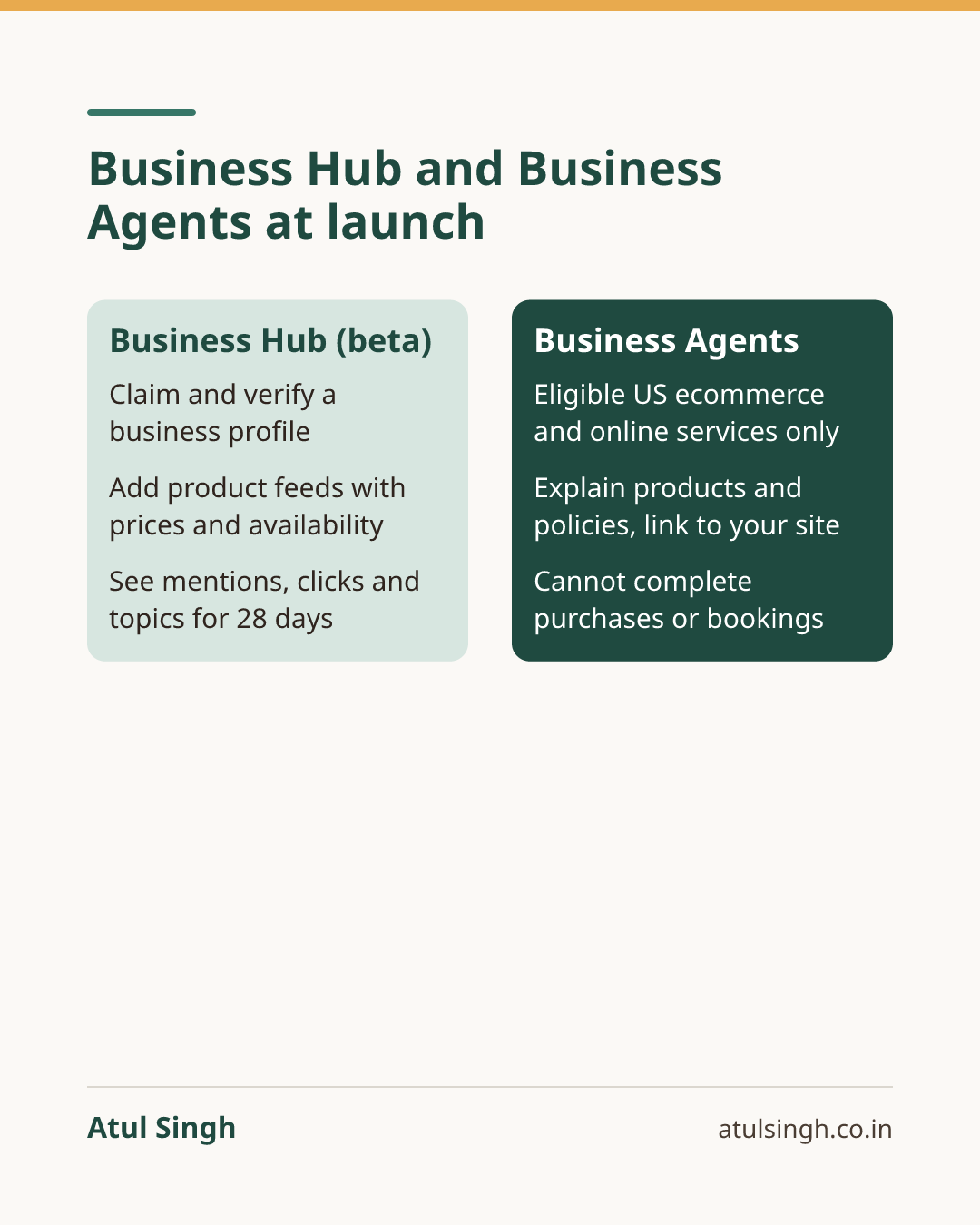
- Eligible businesses located where ChatGPT is available can claim a profile through Business Hub; verified businesses can update details and add product feeds with prices and availability.
- Insights cover the past 28 days of mentions, website clicks and discovery topics. Businesses do not receive individual prompts or customer conversations.
- Business Agents are for eligible US ecommerce and online-service businesses with a website. They can explain products and policies but cannot complete purchases, bookings or order checks.
- Claiming a business does not guarantee more visibility, and advertising does not influence ChatGPT's independent recommendations.
What changed
OpenAI announced Businesses in ChatGPT as a beta on 10 November 2026. The company said ChatGPT is used by 1.2 billion people each week. The launch has two parts: Business Hub and Business Agents.
Business Hub lets an eligible business located where ChatGPT is available claim its profile. Once verified, it can update key details and add self-service product feeds with pricing and availability. Shopify merchants can connect their store from Business Hub or the Shopify admin, and eligible Shopify products are already integrated through Shopify Catalog. Existing OpenAI Enterprise customers and advertisers can work through their OpenAI representative. OpenAI's Help Center says an Ads account or Enterprise agreement is not required to claim.
Business Hub also shows aggregated activity: mentions, website clicks and discovery topics, meaning common themes in conversations where the business's website is cited. The window is the past 28 days. Businesses do not see individual prompts or conversations, and blank metrics can simply reflect reporting thresholds.
The second part is the Business Agent. When a business appears in a ChatGPT answer, people can open its profile. If an agent exists, they can start a clearly labelled conversation, separate from their original chat, to compare options and ask follow-up questions. At launch, agents are for eligible US ecommerce and online-service businesses with a website, and they need separate eligibility from profile claiming.
The current agent can explain products and policies and link to the business website. It cannot complete purchases, bookings or order checks. Local stores and restaurants can currently claim only an existing US listing.
Businesses can also sponsor their agent and use it as the destination for ChatGPT Ads, with sponsored placements labelled. OpenAI says it plans to expand to more markets and categories, and its launch post gives no timetable. BigGo Finance reports that OpenAI declined to detail its verification methods at a press briefing.
Why it matters
OpenAI says people are turning to AI to discover and compare products. It describes this launch as an early step in bringing businesses into that process. The profile gives a business a direct way to provide its own details to ChatGPT.
There are limits. OpenAI does not promise that claiming a profile improves recommendations, and it says ads do not influence its independent answers. The insights are aggregated and thresholded, so they do not give lead-level data you can follow up. The launch post also does not say whether Business Hub or Business Agents will carry fees.
The agent cannot take an order or booking, so the sale still happens on your own website. That makes the quality of your site, prices and policy pages the part you control. For a small team, the sensible step is low-cost preparation of information you already own.
Who it affects
Show me first
Founder
You decide whether the business is eligible and who owns the claim. Check Business Hub for your location and business type, since eligibility depends on both and on verification. Fees are not stated, so avoid committing budget yet.
Marketing
Product feeds carry prices and availability, so marketing owns the accuracy of descriptions and offers. Discovery topics show themes in conversations where your website is cited, which can guide what your pages should explain. Engagement data comes as aggregate counts, such as mentions and website clicks.
Support
The agent can explain products and policies. Your returns, delivery, warranty and pricing answers need to be clear and consistent in writing. Support is also the team that knows which questions buyers ask most often.
Operations
Someone has to keep prices and availability current in any feed, and the agent hands customers to the website for purchases and bookings. That means checking that the website's checkout or enquiry path works.
What to do now
Open Business Hub and check whether your business can claim a profile.
Eligibility depends on location, business type and verification, so confirm it yourself before paying anyone who promises results.Put your products or services in one clean sheet with name, description, price and availability.
If you use Shopify, check how your store connects to Business Hub.List the questions customers ask most often before buying, and write plain answers for returns, delivery, warranty and pricing.
Publish them on your website, since agents link there.Test the path from your website to a purchase or enquiry on a phone.
The agent cannot complete purchases or bookings, so your site has to.Name one owner for business information and set a monthly review date.
Any price or policy change needs a person's approval before it goes out.
Ticks stay in this browser only.
Atul's take

Atul Singh
AI workflow and adoption consultant
In my view, this deserves a few hours of tidy-up work, and the work pays off whatever ChatGPT does next. Current prices, clear policies and accurate descriptions help your website, your WhatsApp replies and your sales team too. I would be cautious about the storefront talk. The agent cannot take orders yet, OpenAI promises no extra visibility, and agents are US-only for now. One person should own the information and approve every price or policy change, because a wrong price in an AI answer is a customer promise. I would hold off spending money until fees and wider markets are clear.
My view, not a reported fact
AI workflow and adoption consultant
I help businesses put AI to work in their sales, marketing and customer support teams.
Read more about Atul →Book a 30-minute workflow reviewQuestions people ask
OpenAI says any eligible business located where ChatGPT is available can claim through Business Hub. Eligibility depends on location, business type and verification, so check Business Hub for your own case. Local stores and restaurants can currently claim only an existing US listing.
OpenAI says claiming does not guarantee more visibility or control over ChatGPT's independent recommendations. It also says advertising does not influence those answers. Claiming mainly gives you a way to supply accurate details and see aggregate activity.
No. Businesses see aggregated mentions, website clicks and discovery topics, and only when thresholds are met. OpenAI does not share user conversations or Business Agent chats with businesses, and fees for the products have not been stated.
Check what you learned
Three questions. Your answers stay on this page and are not saved.
Sources
Official source
Introducing Businesses in ChatGPT (opens in a new tab)
How this was made. Researched and drafted with AI, checked against the sources listed below, with Atul's views from his published positions.