
The short answer
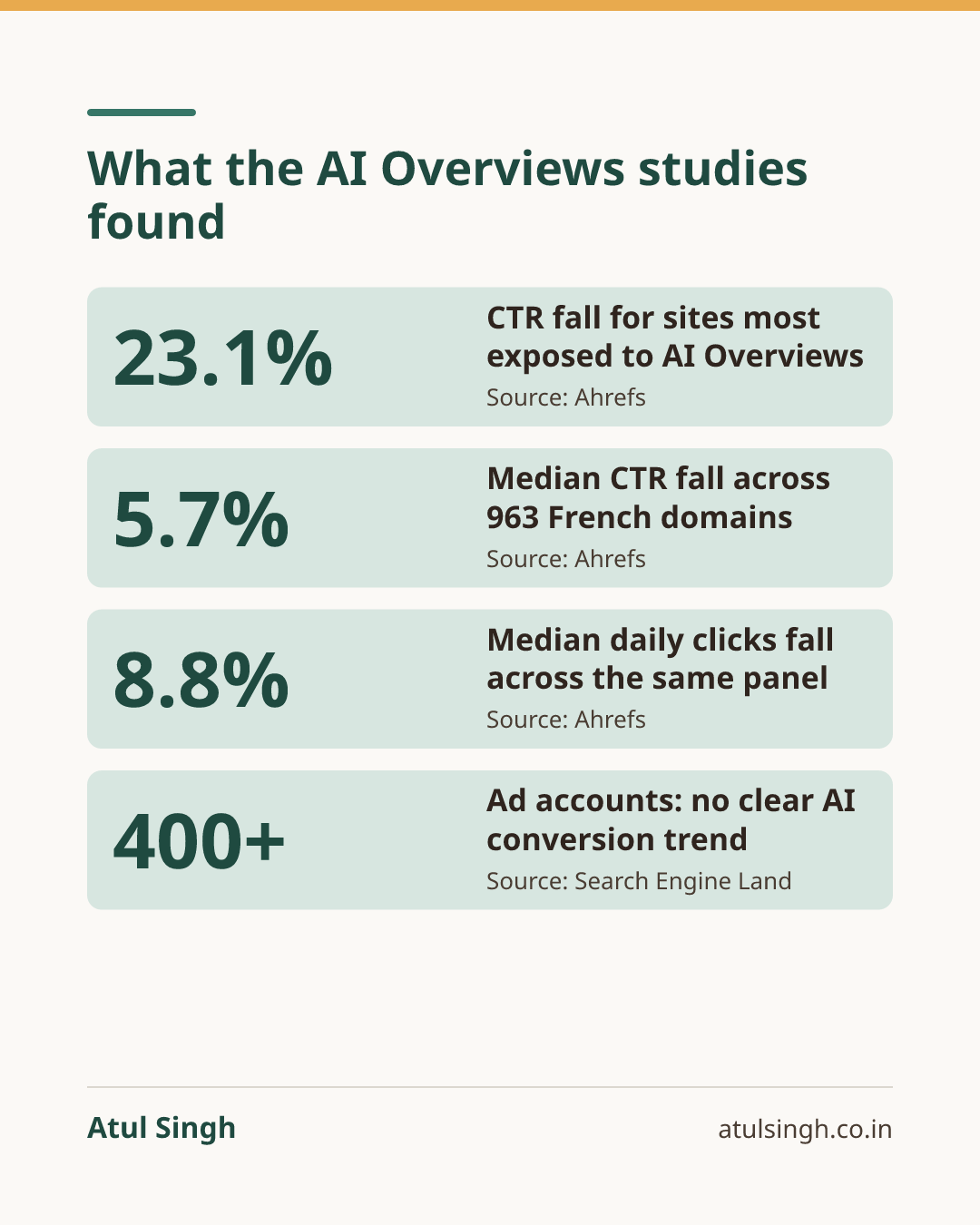
Google launched AI Overviews in France on 22 July 2026. Ahrefs found median click-through rate fell 5.7% across 963 top domains in the nine days after launch. Where AI Overviews appeared on over 20% of queries, it fell 23.1%. A separate analysis of 400+ Google Ads accounts found no clear conversion shift linked to AI search. Check your own Search Console and conversion data before changing budgets.
At a glance
- AI Overviews arrived in France on 22 July 2026. Ahrefs compared 28 days before launch with nine days after for 963 high-click domains.
- Where AI Overviews triggered on more than 20% of queries, median CTR fell 23.1%, and 82.2% of that group lost CTR.
- Across the full panel, median CTR fell 5.7% and median daily clicks fell 8.8%.
- An analysis of 400+ Google Ads accounts found no clear increase in longer queries or a conversion trend attributable to AI search.
- Google says AI Overview and AI Mode ad metrics are included in aggregate standard campaign reporting.
What changed
Google launched AI Overviews in France on 22 July 2026. Ahrefs took the 1,000 highest-click French domains and kept the 963 with enough Search Console history. It compared the 28 days before launch with the nine days after.
Across that panel, median click-through rate (CTR, the share of impressions that become clicks) fell 5.7%, and median daily clicks fell 8.8%. For domains where more than 20% of queries triggered an AI Overview, median CTR fell 23.1%, and 82.2% of that group lost CTR. Ahrefs also reported one extreme site whose impressions rose 183% while clicks fell 1.9%.
On 9 November, consultant Glenn Gabe shared five French Search Console examples. Three sites lost clicks and two stayed relatively stable. At one site, daily clicks fell from about 750 to 400 and CTR from 2% to 1.1%, while impressions stayed stable.
The advertising picture is less clear. An analysis of 400+ Google Ads accounts covered Search and Performance Max campaigns from Q1 2024 through Q3 2026. It found no clear increase in longer reported queries and no conversion trend attributable to AI search. Google says AI Overview and AI Mode ad metrics, including impressions, clicks, conversions and cost, are included in aggregate standard campaign reporting. Triggering queries are included in aggregate in the search terms report.
At Alphabet's Q3 earnings call on 28 October 2026, Chief Business Officer Philipp Schindler spoke about AI Mode. He said strong AI Mode query growth affected Search revenue growth because of lower monetisation in AI Mode. The cited materials give no rate per conversion and no dollar figure for that effect.
The evidence has limits. Ahrefs measured a short window in one country. Gabe's evidence is five individual site examples. The Google Ads analysis could not isolate AI placements in the reports and noted sample limitations.
Why it matters
A rise in impressions from AI features is visibility. It does not automatically bring visits, qualified leads or revenue. The Ahrefs extreme case, with impressions up 183% and clicks down 1.9%, shows how far the two can move apart.
A report that tracks rankings or impressions alone could look healthy while visits fall. Judge performance by market, page and query intent, and check it against enquiries and sales you can verify yourself.
Query type may matter. Ahrefs argues that a query a single paragraph can answer is more exposed. A query that needs a tool, an account, a price or a purchase holds up better. That is Ahrefs' interpretation, so test it on your own pages.
On the ads side, Google includes AI-feature metrics and triggering queries in aggregate reporting. The account study could not isolate AI placements. Your own conversion tracking therefore carries more weight than the search terms report.
The evidence does not support blanket cuts to SEO or paid budgets. Results varied by site, and the Ads-account analysis found no clear conversion shift. Almost half the Ahrefs panel lost more than 10% of daily clicks, and 5% lost more than half, so the spread between sites is wide.
Who it affects
Show me first
Founder
Budget calls on SEO, content and ads should wait for your own numbers. The studies show wide variation between sites, so a headline figure from France may not reflect your business.
Marketing
Check whether impressions and clicks have drifted apart on your key pages, as they did at the site Gabe described. If you run Search or Performance Max, Google includes AI-placement metrics in aggregate campaign reporting. The 400+ account study could not isolate them.
Sales
Fewer organic clicks could mean fewer enquiries from content pages that used to bring them. The studies here measure clicks and ad metrics, not lead volume. Your CRM lead-source field is the place to look.
What to do now
Export Search Console data for your top pages and queries.
Compare clicks, impressions and CTR for the last 28 days against the 28 days before, and split by country. Flag pages where impressions held or rose while clicks fell.Sort your top queries by intent.
Mark those a short paragraph can answer, and those that need a price, a tool, an account or a human opinion. Watch the first group most closely.Check your ad conversion tracking against first-party records such as CRM entries, form fills and WhatsApp enquiries.
Do not judge ad results from the search terms report alone.Ask a sample of new leads and callers how they found you, and record the answer in a source field.
Write down today's baseline numbers with the date.Make no blanket budget cut this month.
If your own data shows a clear drop on specific pages, adjust only those and set a review date four weeks out.
Ticks stay in this browser only.
Atul's take

Atul Singh
AI workflow and adoption consultant
This is opinion. The France data is real and worth taking seriously, but it covers nine days and one market, and the Google Ads study found no clear conversion change. I would not move a budget on either result.
The number I trust most for a small business is its own: enquiries and sales by source, tracked in a sheet or CRM that a second person can read. Impressions and rankings are useful for spotting trouble. They do not show whether the business is earning. If your lead-source tracking is patchy, fix that first. It will serve you whatever Google does next, and the right budget decision then follows from your own data.
My view, not a reported fact
AI workflow and adoption consultant
I help businesses put AI to work in their sales, marketing and customer support teams.
Read more about Atul →Book a 30-minute workflow reviewQuestions people ask
The sources do not support a blanket cut. Click losses varied widely between sites, and the Ads-account analysis found no clear conversion shift. Check your own pages and conversions first, and adjust only where your data shows a clear drop.
Only partly. Google says AI Overview and AI Mode metrics are included in aggregate campaign reporting, and triggering queries are included in aggregate in the search terms report. The 400+ account analysis could not isolate AI placements.
The cited sources have no India-specific or Gulf-specific traffic study. Look at Search Console by country and compare impressions with clicks for your key pages. India is among the markets where Google is expanding AI Mode ads.
Check what you learned
Three questions. Your answers stay on this page and are not saved.
Sources
Official source
AI Overviews Cut CTR by 23.1% in France (opens in a new tab)Alphabet Investor Relations
Alphabet Investor Relations – 2026 Q3 Earnings Call (opens in a new tab)Google Ads & Commerce Blog
Ads in AI Mode expand to new markets (opens in a new tab)
How this was made. Researched and drafted with AI, checked against the sources listed below, with Atul's views from his published positions.