
The short answer
OpenAI began rolling out ChatGPT Wallet on 13 November 2026. It lets OpenAI's dots agents pay for a purchase after the user approves it with a security check such as Face ID. Launch is limited to US ChatGPT Pro subscribers with US-issued cards. Merchants keep control of pricing, fulfilment and returns, but sites or payment-risk systems may block legitimate agent orders, so stores selling to US shoppers should check their setup.
At a glance
- OpenAI dated the ChatGPT Wallet announcement 13 November 2026 and said rollout began that day through its dots agents.
- Launch covers US ChatGPT Pro subscribers aged 18 or older with eligible US-issued cards.
- A payment token replaces the real card details, so neither the business nor the agent receives them.
- OpenAI says some sites or payment-risk systems may block legitimate agent purchases.
- CNBC reported that OpenAI is not taking a cut of transactions at launch.
What changed
OpenAI began rolling out ChatGPT Wallet on 13 November 2026 through dots, its agents. At launch it is limited to ChatGPT Pro subscribers aged 18 or older in the US who hold eligible US-issued cards. OpenAI built it with American Express, Mastercard and Visa.
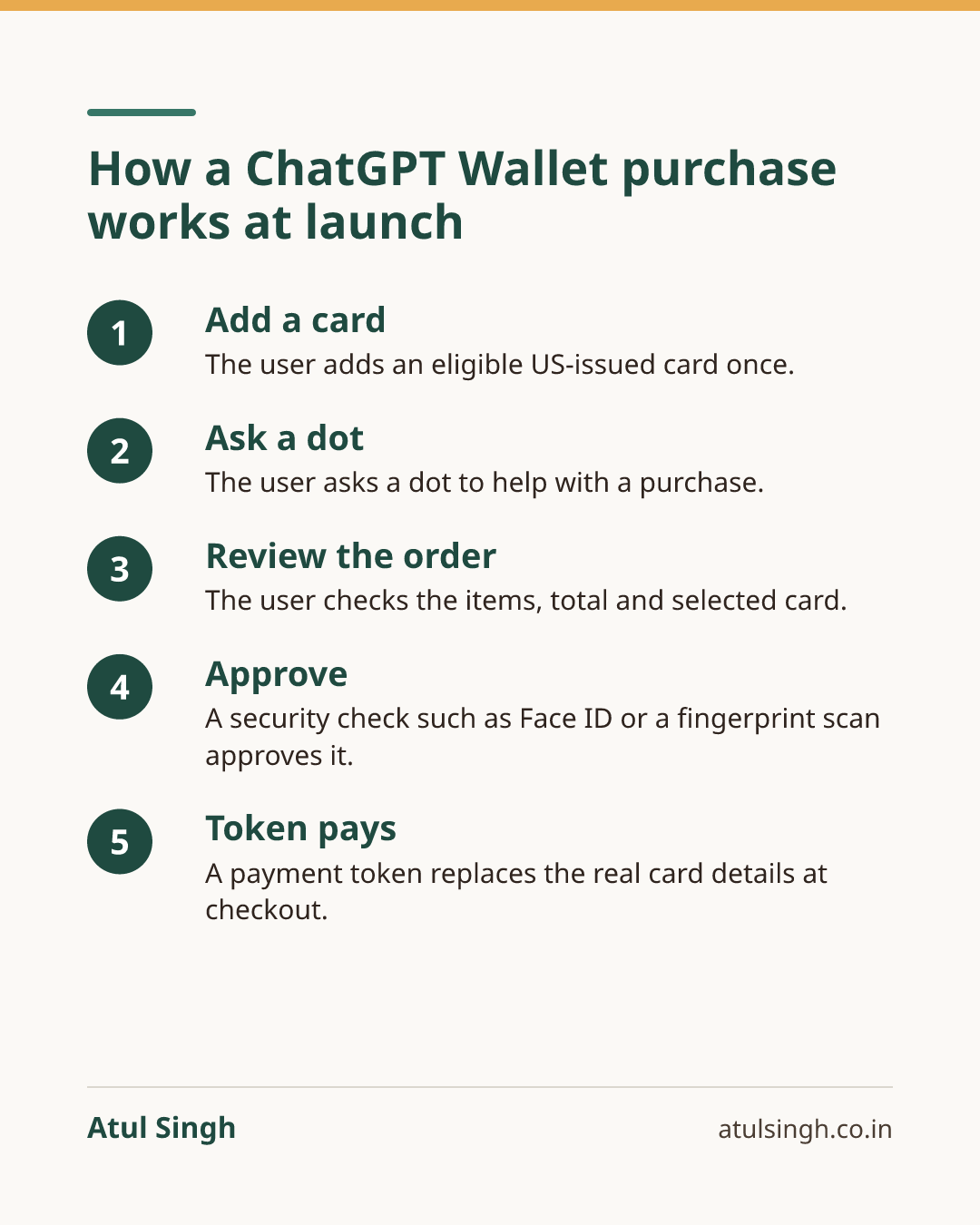
A user adds a card once, then asks a dot to help with a purchase. Before each order the user reviews the items, total and selected card, and approves with a security check such as Face ID or a fingerprint scan.
After approval, the payment network issues a token that stands in for the real card details, so neither the business nor the agent sees them. The shopper keeps card rewards and protections for eligible disputes.
Every purchase at launch needs the user's approval, so this is supervised checkout. OpenAI expects to add fully delegated purchases later, with spending limits, purchase categories or time periods, but describes these as future controls.
Alongside the launch, OpenAI published a Commerce Partner Playbook. It tells merchants to claim their business in ChatGPT and upload a product feed with current pricing and availability. It also tells them to configure their CDN or firewall to recognise signed requests using Web Bot Auth, and to talk to their payment and risk providers.
Why it matters
For a store, this is an early and limited channel with no promise of new orders. Only US Pro subscribers can use it, and OpenAI says it is starting small to learn from real use.
The practical risk is that a store turns away agent orders without noticing. OpenAI says Wallet tokens work with existing checkout flows, but risk systems may still flag legitimate agent purchases and cause declines or cancellations. Some sites may also block agents without meaning to.
The customer relationship stays with the merchant, including pricing, fulfilment, returns and customer service, so order, return and refund questions go to the merchant. CNBC reported that OpenAI is not taking a cut of transactions at launch, and the sources reviewed do not specify other fees.
OpenAI has not said when Wallet will expand beyond the US.
Who it affects
Show me first
Founder
Decide whether US shoppers matter to your store. If they do, the checks below are worth doing this month. If they do not, keep Wallet on a watch list.
Marketing
OpenAI asks merchants to keep a product feed current, with accurate pricing and availability. Whoever owns the product catalogue owns this task.
Support
Expect order, return and refund questions on agent-placed orders to reach your team, because merchants keep responsibility for returns and customer service.
Operations
The person who manages the website, CDN, firewall and payment setup owns the risk of agents being blocked or purchases being declined.
What to do now
Check how many of your customers are in the US.
If the number is small, put Wallet on a watch list instead of starting a project.Ask your payment provider and any fraud-prevention provider how they treat agent purchases made with Wallet tokens, and whether wrongly declined orders can be reviewed.
Ask your web developer whether your CDN or firewall blocks ChatGPT agents, and read the Web Bot Auth section of OpenAI's Commerce Partner Playbook.
Audit your product catalogue for current prices and stock.
If US sales matter, claim your business in ChatGPT and upload a product feed.Brief your support team that returns and refunds on agent-placed orders stay with you, and agree who answers them.
Ticks stay in this browser only.
Atul's take

Atul Singh
AI workflow and adoption consultant
My view, as opinion: I would not spend a project on this if your customers are in India or the Gulf. Wallet is US-only and OpenAI has said nothing about other markets. For a store with US customers, the work is dull but useful: keep the catalogue accurate, make sure the firewall is not turning away legitimate visitors, and ask your payment provider how it handles agent orders. Those are worth fixing anyway. I like that every purchase needs a person's approval, because AI can prepare the order while a human approves anything involving money. I would wait for the spending-limit version before changing any real process around agent orders.
My view, not a reported fact
AI workflow and adoption consultant
I help businesses put AI to work in their sales, marketing and customer support teams.
Read more about Atul →Book a 30-minute workflow reviewQuestions people ask
Wallet is for US users only at launch, and shoppers need a US billing address and a US-issued card. The sources reviewed do not address merchants outside the US, and OpenAI has not announced when Wallet will expand.
CNBC reported that OpenAI is not taking a cut of transactions at launch. The sources reviewed do not specify any other fees or commercial terms.
OpenAI says a site may block agents unintentionally, or a payment-risk system may flag a legitimate agent purchase and decline or cancel it. Wallet tokens work with existing checkout flows, so the fix usually sits with your website settings and payment or fraud providers.
Check what you learned
Three questions. Your answers stay on this page and are not saved.
Sources
Official source
Introducing ChatGPT Wallet (opens in a new tab)
How this was made. Researched and drafted with AI, checked against the sources listed below, with Atul's views from his published positions.