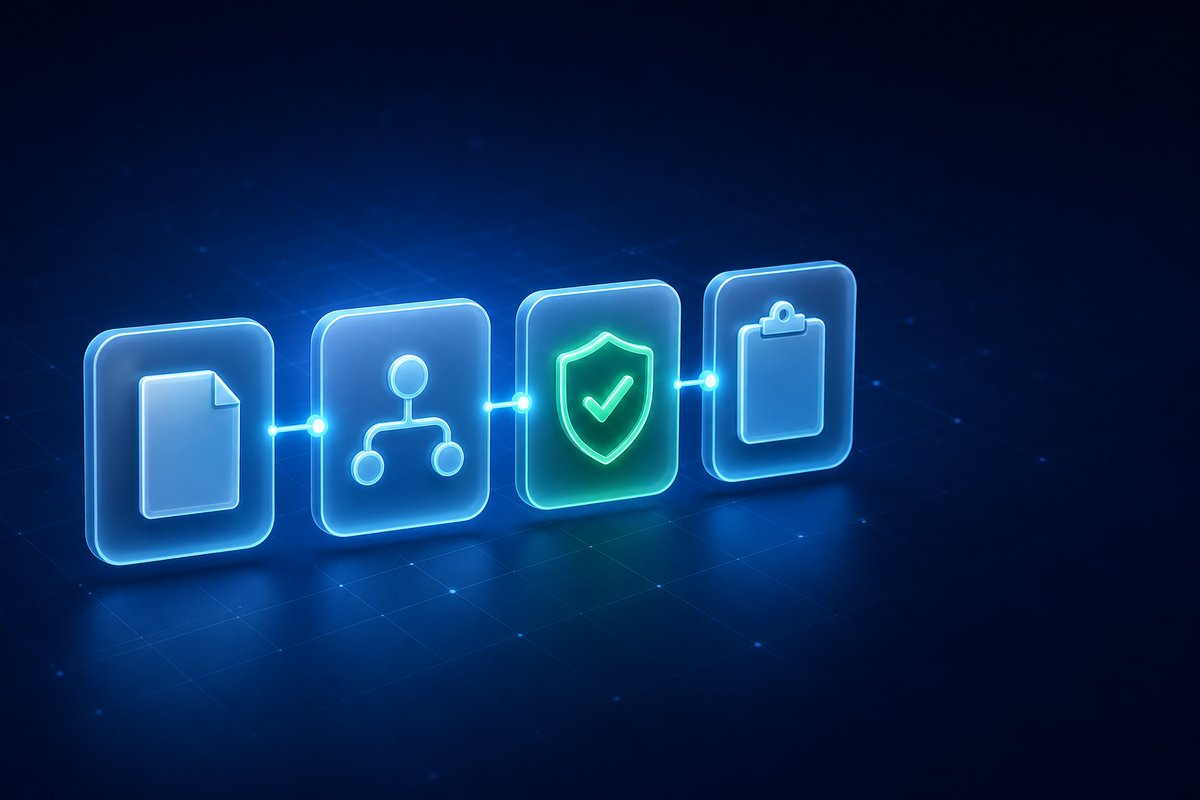
Most organisations do not have an AI adoption problem. They have a workflow design problem.
A team can experiment with writing assistants, meeting tools, research systems and automated analysis yet see little organisational value. The reason is usually straightforward: the technology has been added to existing work without changing how responsibilities, review points and decisions are organised.
A more useful leadership question is: where can AI help a less experienced person handle more complex work safely, while keeping accountability with the right human?
That shift matters because the strongest opportunity may not be replacing expert work. It may be using AI to flatten the expertise curve: helping newer employees produce better first drafts, identify issues earlier and prepare work that experienced colleagues can review efficiently.
Why AI adoption depends on workflow design
AI adoption often starts with procurement. Someone chooses a tool, gives the team access and asks people to find uses for it. This can produce isolated productivity wins, but it rarely creates a dependable operating model. Teams that have accumulated tools without changing work can use the 4D AI fluency framework to structure the move from experimentation to governed practice.
Consider a small professional services team. A junior employee spends most of Monday gathering background information, checking documents and preparing a client briefing. A senior colleague then spends an hour correcting structure, finding missing risks and rewriting the recommendation. Giving the junior employee an AI assistant may speed up the first draft, but it does not automatically solve the underlying problem.
A practical AI workflow redesign answers four questions:
- What is the AI responsible for? For example, organising source material, producing a first-pass summary or identifying inconsistencies.
- What must a person verify? This might include facts, calculations, client-specific assumptions and recommendations.
- Where does review happen? The senior colleague should not discover every problem at the end of the process if an earlier checkpoint can catch it.
- Who owns the final decision? AI can support preparation, but a named person remains accountable for what is sent to a client or used in an operational decision.
The result is not simply faster drafting. It is a new sequence of work in which the junior employee can take on more of the preparation, the senior employee focuses on judgment and the organisation has a visible control point before delivery.
The Stanford Graduate School of Business article How AI is Reshaping the Future of Work makes this leadership point directly: the effect of AI depends heavily on the conditions leaders create, including how teams share information and respond to uncertainty.
AI as an expertise leveler for less experienced employees
The article cites research by Danielle Li, Lindsey R. Raymond and Erik Brynjolfsson reporting productivity gains from generative AI, with the strongest gains among less experienced workers. It also cites research by Chloe Xie and Jung Ho Choi on accountants using AI to automate repetitive work and flag issues in real time.
The management implication is significant. If AI helps newer employees perform closer to the level expected by a more experienced colleague, leaders may be able to redesign team capacity — not by removing expertise, but by using it differently.
A practical example is an accounting workflow:
- A less experienced accountant prepares the initial analysis.
- AI handles repetitive comparisons and highlights unusual items.
- The accountant records why each flagged item was accepted, investigated or escalated.
- A senior accountant reviews exceptions, assumptions and the final conclusion.
- The organisation retains an audit trail showing both the AI-supported work and the human decisions.
This arrangement gives the junior employee a broader learning surface. Instead of spending all of their time on mechanical checking, they encounter more meaningful issues. The senior accountant spends less time on baseline processing and more time on interpretation, risk and client communication.
The same pattern can apply to sales, marketing and operations. A newer salesperson might use AI to organise account research and prepare discovery questions, while a manager reviews the business assumptions and positioning before an important meeting. A marketing coordinator might use AI to create a campaign brief from approved materials, while a senior marketer checks the audience insight, claims and commercial objective. For the sales example, the B2B demo preparation workflow shows how AI can gather account context and turn it into relevant discovery questions before a meeting.
In each case, AI is not being asked to supply expertise from nowhere. It is accelerating synthesis and preparation, while experienced people provide context, judgment and correction.
How to measure AI-assisted work
When AI changes how work is produced, measuring performance only by volume becomes less useful. A person may produce more documents, analyses or messages while making weaker decisions or introducing more unverified claims.
Leaders should therefore assess both output and judgment. Useful review criteria include:
- Did the employee identify the important uncertainty?
- Did they distinguish verified information from an AI-generated suggestion?
- Did they escalate a material risk at the right point?
- Can they explain why the final recommendation is appropriate?
- Did they communicate clearly with the customer, colleague or stakeholder affected by the decision?
This is especially important when AI allows less experienced employees to handle work that previously required more direct senior involvement. The organisation gains capacity only if the new capacity is paired with sensible boundaries.
For a sales team, for instance, a useful measure is not simply the number of personalised messages produced. It could include the quality of account selection, the accuracy of the business problem identified and the proportion of messages that received a relevant human review before being sent.
For a customer support team, it might be better to track whether AI-assisted responses resolve issues accurately and escalate sensitive cases appropriately, rather than rewarding agents for closing the largest number of tickets.
The principle is simple: measure the quality of decisions and risk handling, not just the amount of AI-assisted output.
Embed governance inside the workflow
An AI governance policy saying “check AI outputs” is not enough. If verification is separate from the work, busy teams will often skip it or apply it inconsistently. Governance is more reliable when it is built into the workflow itself.
A lightweight control structure might include:
- Approved use cases: Define which tasks AI may support, such as summarising internal material or drafting a first version from approved information.
- Restricted inputs: Specify what must not be entered into the system, including confidential client data or sensitive personal information unless the approved environment and controls allow it.
- Mandatory review points: Require human checking before external communication, financial decisions, regulated activity or material changes to customer records.
- Escalation rules: Make clear which errors, uncertainties or unusual cases must go to a manager or subject-matter expert.
- Traceability: Keep enough information to understand what was generated, what was changed and who approved the final result.
- Feedback loops: Review recurring errors and update the workflow, prompts, reference material or training accordingly.
These controls should be proportionate to the risk. A draft of an internal brainstorming note does not need the same process as a client recommendation or financial analysis. But every workflow should make accountability visible.
A useful implementation exercise is to choose one recurring process and map it from trigger to final decision. Mark the steps that are repetitive, the points where junior staff get stuck, the decisions that require expertise and the risks that would be costly to miss. Then introduce AI only where it improves a specific step, with a named reviewer and a defined stop condition.
What can go wrong
The expertise-leveling effect is not automatic. AI can help a less experienced employee produce a stronger draft, but it can also make incorrect work look polished. This creates a particular risk: a junior employee may not yet have enough subject knowledge to recognise a confident but flawed answer.
There are several common failure modes:
- Automation without redesign: The team adds AI to an inefficient process and simply produces more work of the same quality.
- Review after the point of influence: A senior person approves the final output without seeing the assumptions or source material that shaped it.
- False confidence: Employees treat fluent language as evidence of accuracy.
- Unclear ownership: Everyone assumes someone else checked the result.
- Output-based incentives: Teams are rewarded for speed or volume, encouraging shallow verification.
- Experimentation without adoption: Individuals try tools, but no one converts successful experiments into a documented, repeatable workflow.
AI also does not replace foundational domain knowledge. It can accelerate synthesis, but people still need enough understanding to frame the task, challenge the result and recognise when an answer is unsafe or incomplete.
The right response is not to block experimentation. It is to place experimentation inside a controlled learning cycle: define the task, test the workflow, inspect the errors, measure the outcome and decide whether the process is reliable enough to standardise.
A practical starting point for leaders
Begin AI adoption with one junior bottleneck rather than a broad rollout.
Ask the team:
- Which recurring task consumes substantial time before an experienced person can add value?
- Where do less experienced employees need help to reach a useful first result?
- Which parts can AI assist with safely?
- What must remain a human decision?
- What evidence should a reviewer see before approving the work?
Then run a small pilot with a written workflow. Define the input, AI-supported step, human review, escalation rule and success measure. For example, success might mean reducing senior review time while maintaining accuracy — not simply generating more drafts.
After two or three cycles, review the failure cases. If people cannot explain why the output is correct, the workflow is not ready to scale. If the process works, document it and train the team on the decisions around the tool, not just the tool's features. When the process works, the next training step is to teach the decisions around it; training around real workflows provides a useful model for that shift.
AI adoption is therefore an organisational design challenge. Leaders create value when they use AI to expand what less experienced employees can safely do, reserve human expertise for judgment and risk, and make oversight part of the work itself.