A manager can care deeply about developing people and still spend most of the week reacting to deadlines, reviewing work, and completing performance administration. The result is a familiar gap: the organisation says managers should coach, but the workflow rewards evaluation and task control.
AI can help close that gap, but not by replacing the human part of coaching. Its most useful role is narrower and more practical: preparing managers for better conversations, highlighting patterns they might miss, and reducing the documentation burden that pushes development work aside.
The Lattice article presents this as a shift from the manager as a traditional evaluator to the manager as a developer of people. That shift requires more than a workshop. It requires repeatable habits supported by usable information and well-timed prompts.
From evaluator to coach: the behaviour change that matters
An evaluator primarily asks whether work met expectations. A coach asks what is helping or blocking progress, what the employee is learning, and what support would improve the next result.
That does not mean managers stop setting standards or addressing poor performance. Coaching-oriented management still includes accountability. The difference is that performance information becomes the starting point for a useful conversation rather than the final judgement.
For example, a sales manager may notice that a representative's opportunities are moving more slowly through the pipeline. An evaluator might mention the decline during the next formal review. A coach would investigate earlier:
- Which stage is creating the delay?
- Is the issue lead quality, discovery, follow-up, or confidence in a particular type of deal?
- What evidence would show improvement over the next two weeks?
- What support should the manager provide?
AI can help organise the evidence and suggest questions. It cannot reliably determine the cause from a metric alone, and it should not be allowed to make the judgement on the manager's behalf.
This is why the strongest use case is a coaching prompt engine. The system turns goals, feedback, review information, and other authorised performance inputs into preparation material. The manager then applies context, judgement, empathy, and accountability.
Three practical workflows for AI-assisted coaching
1. Prepare for a weekly one-to-one
A one-to-one meeting often fails when it becomes a status update with no attention to development. A lightweight AI-supported preparation workflow can make the conversation more purposeful.
Before the meeting, the manager reviews a short summary containing:
- The employee's current goals.
- Recent progress or changes in performance information.
- Previous commitments from the last meeting.
- Any unresolved obstacles.
- Two or three suggested coaching questions.
The manager should then edit the summary before using it. A useful prompt might be: “What has changed since the last meeting, and what open question would help understand why?” A weak prompt would ask the system to assess whether the employee is performing well, because that encourages an unsupported conclusion.
In a customer success team, for instance, the preparation might reveal that a team member has met renewal targets but has repeatedly delayed internal escalation on at-risk accounts. The conversation can focus on the decision process and support needed, rather than producing a vague statement about being more proactive.
The output is not a script. It is a small set of evidence-based prompts that helps the manager spend the meeting listening and exploring instead of searching through notes.
2. Turn performance trends into timely coaching
Formal reviews are too infrequent to carry the full burden of development. AI-enabled performance tools can help surface changes in goals, feedback, or progress so a manager does not wait until the end of a quarter to respond.
A practical workflow looks like this:
- Define which signals are relevant to the role.
- Set a review rhythm for managers to inspect those signals.
- Ask the system to identify changes or recurring themes.
- Require the manager to verify the underlying information.
- Convert a verified pattern into a specific conversation or action.
Suppose a project manager's milestones are repeatedly being completed late, while stakeholder feedback remains positive. The appropriate response is not automatically a performance warning. The manager might ask whether estimates are unrealistic, dependencies are unclear, or the employee is absorbing too much unplanned work.
The AI-generated prompt could be: “Several recent milestones moved after their original dates. What constraints were present, and what would make the next estimate more reliable?” That question is more useful than “Why are you missing deadlines?” because it opens an investigation without removing accountability.
The discipline is important: a trend is a reason to ask a question, not proof of a problem.
3. Automate documentation so coaching has continuity
Managers often avoid regular coaching because the administrative work accumulates afterwards. Tools that assist with note-taking, summaries, action items, and scheduling can reduce that friction.
After a meeting, the manager should review and correct the generated notes, confirm what the employee agreed to, and record only what is necessary for the organisation's process. A concise record might include:
- The development topic discussed.
- The employee's stated obstacle or goal.
- The agreed action.
- The owner and target date.
- The point to revisit next time.
This creates continuity between conversations. In a product team, an employee who wants to improve stakeholder communication might agree to lead the next client update and request feedback afterwards. The next one-to-one can begin by reviewing that specific commitment rather than restarting the discussion from scratch.
Automation is therefore a prerequisite for coaching, not the purpose of coaching. If documentation becomes the main output, the organisation has digitised administration without changing management behaviour.
How HR and business leaders can implement it responsibly
Start with a management behaviour, not a software feature. Decide what the organisation wants managers to do more consistently: hold better one-to-ones, give feedback closer to the event, revisit goals regularly, or create clearer development actions.
Then build a small operating model around that behaviour.
Define the coaching standard
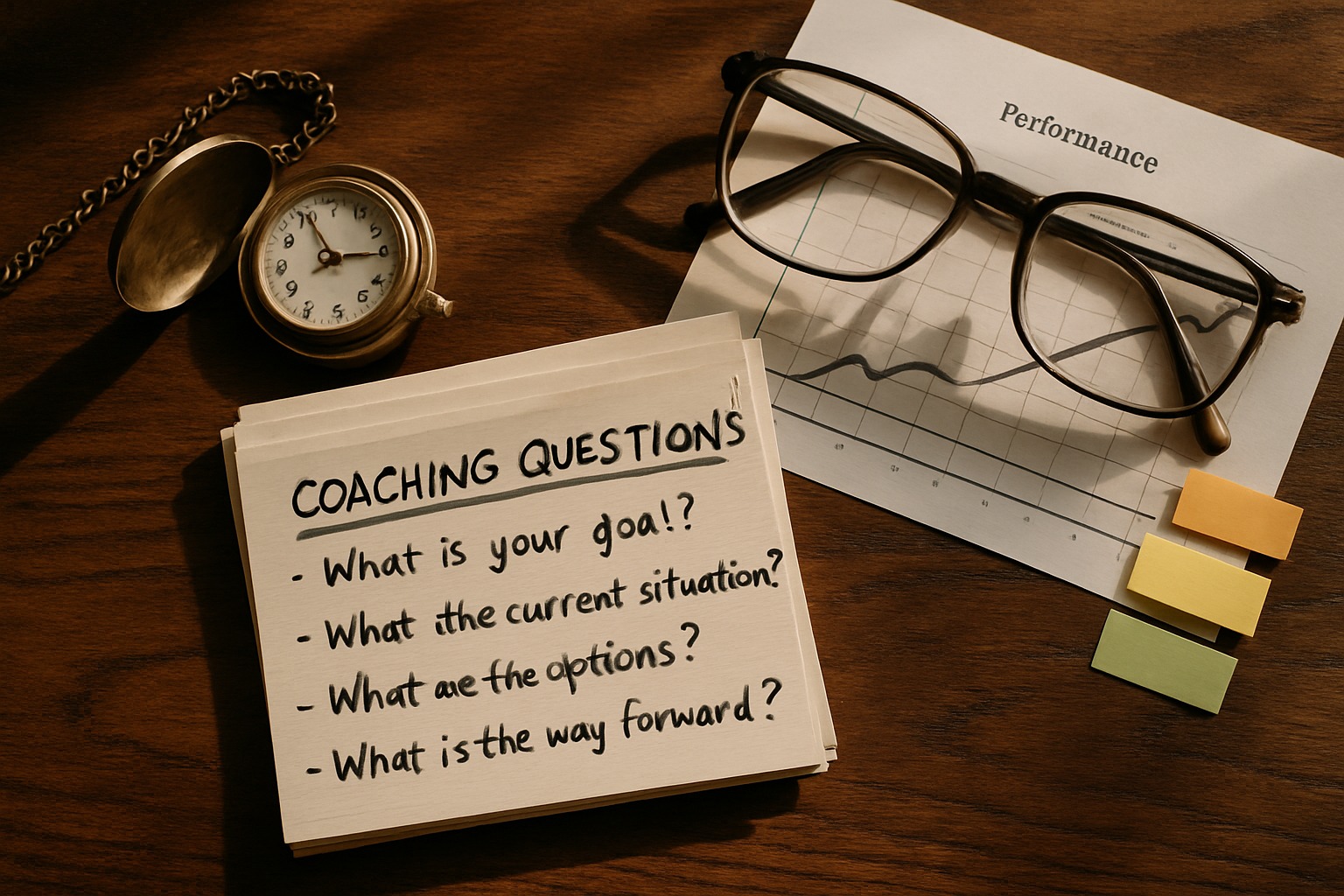
Give managers a shared structure for conversations. The source article recommends coaching fundamentals such as the GROW model: clarify the goal, examine the current reality, explore options, and agree on the way forward. The exact model matters less than having a common language and a repeatable sequence.
Specify approved inputs
Decide what information the AI tool may use. Goals, authorised feedback, meeting notes, and role expectations may be appropriate depending on the system and local policy. Sensitive personal information, rumours, unverified complaints, or data collected without a clear purpose should not be casually added.
Keep the manager accountable for judgement
AI may suggest a prompt or summarise a pattern, but the manager must verify facts, consider context, and decide how to proceed. Managers should never treat an AI-generated summary as an objective record without checking it against the original information.
Pilot one workflow
A practical starting point is weekly one-to-one preparation for one team or department. Measure adoption through observable behaviours: Are managers preparing? Are agreed actions being revisited? Are employees receiving clearer feedback? Avoid treating the number of AI-generated summaries as evidence of better coaching.
Train for conversation quality
Tool training alone will not create coaching capability. Managers need practice asking open questions, listening without prematurely solving the problem, giving direct feedback, and agreeing on specific next steps. AI can lower the preparation barrier, but it cannot compensate for poor conversational habits.
Use AI to prepare, not decide
The safest default is to let AI organise information and suggest questions while leaving interpretation, sensitive judgements, and consequential decisions with the manager and the organisation's established people processes.
Limitations and failure modes
AI-assisted coaching can fail in predictable ways.
First, incomplete or biased performance data can produce misleading prompts. If a system sees activity counts but not the complexity of the work, it may direct attention toward the wrong issue.
Second, employees may experience AI-supported monitoring as surveillance. Organisations should explain what data is used, why it is used, who can access it, and whether it affects formal decisions. Consent and privacy requirements will vary by jurisdiction and context, so they should be reviewed before implementation.
Third, generic prompts can make conversations feel mechanical. A question that sounds thoughtful in isolation may be inappropriate for the employee's circumstances. Managers must adapt the language and be willing to discard the suggestion.
Fourth, automation can reinforce an evaluator mindset if every interaction becomes a score, flag, or risk label. Coaching requires curiosity and trust, not just more measurement.
Finally, claims about improved engagement or management outcomes should be checked before being used to justify an investment. The Lattice article includes a claim about higher engagement among managers trained in coaching and people development, but that statistic should be independently verified before it is presented as evidence.
The practical test is simple: after introducing the tool, are managers having more specific, timely, and human conversations? If not, adding more summaries or prompts will not solve the underlying problem.
AI is most valuable in management coaching when it removes avoidable preparation and administration while preserving human responsibility. Organisations should begin with one repeatable behaviour, use authorised information, train managers in coaching fundamentals, and treat every AI output as assistance rather than fact. That combination turns AI from a reporting layer into a useful nudge toward better management habits.